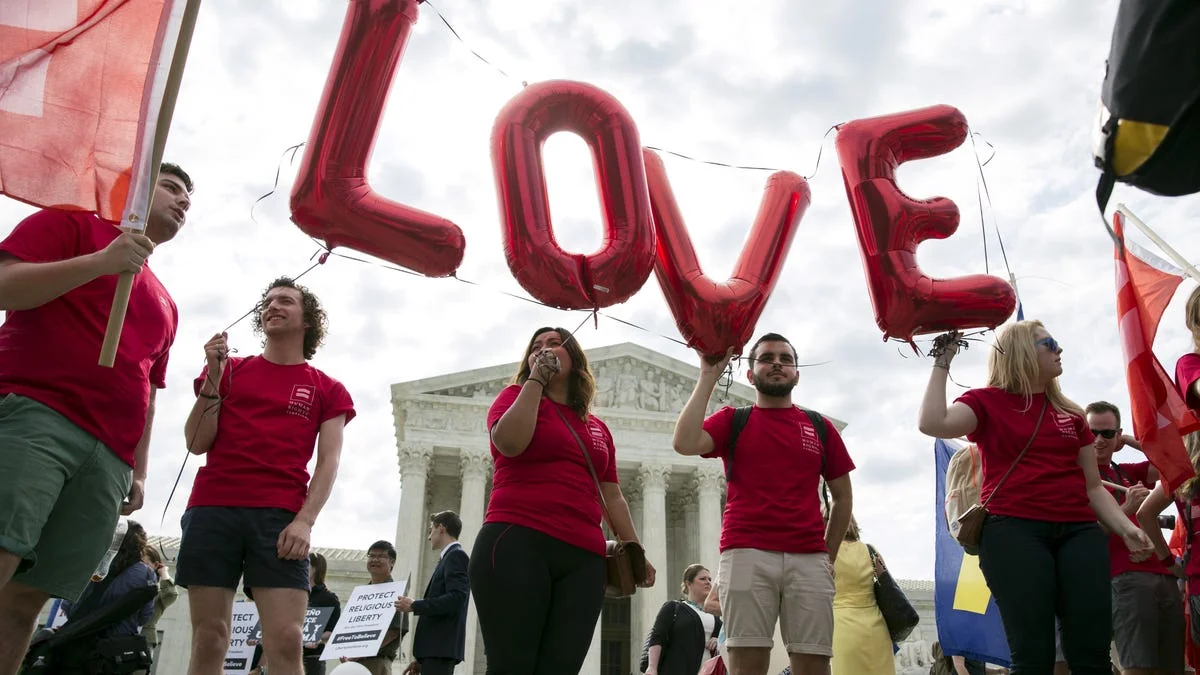
Key Highlights
- The U.S. Supreme Court on Nov. 10 decided not to revisit its landmark ruling that legalized same-sex marriage nationwide.
- Kim Davis, a former Kentucky county clerk who refused to issue same-sex marriage licenses, asked the court to overturn Obergefell v. Hodges.
- The court’s decision to deny review in this case leaves undisturbed a 2015 decision that has been relied upon by LGBTQ+ couples and their families.
- With a conservative majority on the bench, there was speculation about whether the court would reconsider its stance on same-sex marriage after overturning Roe v. Wade in 2022.
The Supreme Court’s Decision and Its Context
The U.S. Supreme Court on Nov. 10 reaffirmed its landmark decision from 2015 that legalized same-sex marriage nationwide, declining to revisit the ruling in a case brought by Kim Davis, a former Kentucky county clerk who refused to issue same-sex marriage licenses due to her religious beliefs.
In 2015, the Supreme Court’s Obergefell v. Hodges decision mandated that states must recognize and license marriages between two people of the same sex. This ruling was hailed as a significant milestone for LGBTQ+ rights, but it has faced ongoing challenges from conservative individuals and groups who oppose its principles.
Kim Davis and Her Controversy
Kim Davis became a household name when she refused to issue marriage licenses to gay couples after the Supreme Court’s 2015 decision. Davis’s actions drew international attention, leading to her arrest for contempt of court and subsequent release after five days in jail.
Despite the public outcry against Davis’s stance, her case did not present clear questions about the constitutionality of same-sex marriage, according to Justice Thomas, who wrote that it “didn’t cleanly present” such questions. Lower courts allowed a lawsuit against Davis by David Ermold and David Moore to proceed, resulting in an order for Davis to pay $100,000 in damages.
The Current Landscape of LGBTQ+ Rights
While the Supreme Court’s decision not to revisit its ruling on same-sex marriage is a significant victory for the LGBTQ+ community, it has been noted that there are still challenges ahead. The Williams Institute at the UCLA School of Law estimates that over 800,000 married same-sex couples exist in the U.S., more than double the number in 2015.
Some legal experts have expressed hope that the court’s decision to deny review will provide stability for LGBTQ+ couples and their families. Mary Bonauto, a senior director with LGBTQ Legal Advocates & Defenders, said, “There’s good reason for the Supreme Court to deny review in this case rather than unsettle something so positive for couples, children, families, and the larger society as marriage equality.”
Conservative Shifts on the Bench
The decision comes against a backdrop of conservative shifts within the Supreme Court. In 2022, the court overturned Roe v. Wade, which had protected the right to abortion nationwide.
Justice Clarence Thomas wrote in that opinion that the justices “should reconsider” past rulings about access to contraception and same-sex relationships.
However, there has not been a similar pushback on marriage rights for same-sex couples as there was for abortion. The current conservative majority of six justices, compared to three more liberal ones, may make it harder for the court to revisit its decision in Obergefell v. Hodges.
As the legal landscape continues to evolve, the Supreme Court’s refusal to revisit its same-sex marriage ruling is seen as a significant milestone that has solidified rights and protections for LGBTQ+ individuals across the United States.