Key Highlights
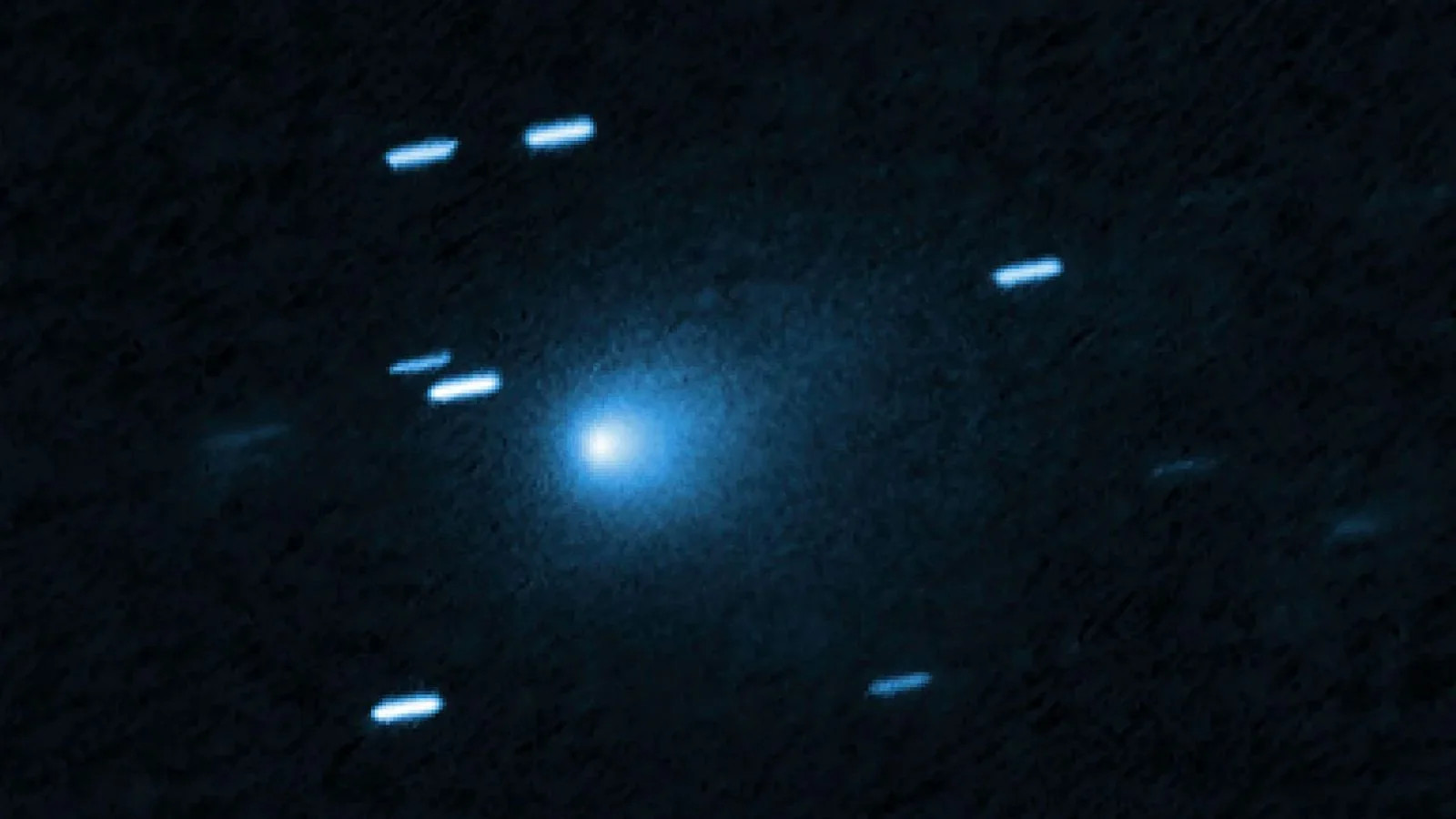
- The interstellar object 3I/ATLAS has developed a faint blueish hue, marking its third color change since discovery.
- This color shift is believed to be caused by specific gases leaking from the comet’s surface.
- 3I/ATLAS reached its closest point to the sun on October 29, enhancing scientists’ ability to study it in detail.
- The comet will become increasingly visible to Northern Hemisphere stargazers over the next few weeks.
The Mysterious Interstellar Comet 3I/ATLAS
Recent observations of the interstellar object 3I/ATLAS, discovered in early July, have revealed a fascinating development: the comet has developed a faint blueish hue. This marks its third significant color change since it was first spotted.
The Blue Shift and Its Implications
According to researchers analyzing data from spacecraft that could still see 3I/ATLAS, this new coloring is likely due to specific gases such as carbon monoxide or ammonia leaking from the comet. This phenomenon stands in stark contrast to its initial red hue observed during early July, which was attributed to an abundance of dust coming off its surface.
Later in September, 3I/ATLAS briefly appeared green, possibly due to dicarbon or cyanide within its coma. However, these color changes have been temporary and the reasons behind them remain a mystery. The current blue hue is the third distinct change observed by experts since the comet’s discovery.
Closest Approach and Enhanced Observations
On October 29, 3I/ATLAS reached its closest point to the sun, known as perihelion, at a distance of approximately 1.4 times Earth’s distance from the sun. This event allowed for enhanced observations by both ground-based telescopes and space observatories like NASA’s Hubble Space Telescope.
These close-up views provided scientists with valuable data to study the comet in greater detail. The Hubble captured a significant image of 3I/ATLAS, showing it as a giant rainbow in the night sky—a result of filters and timelapse techniques used by astrophotographers Michael Jäger and Gerald Rhemann.
Approaching Visibility for Earth-Based Observers
The comet is currently visible to Northern Hemisphere stargazers but will not be observable with the naked eye. Amateur astronomers equipped with decent telescopes or binoculars can catch a glimpse of it as it moves northward in the night sky.
As 3I/ATLAS approaches its closest point to Earth on December 19, at a distance of approximately 1.8 times the Earth-sun distance, researchers will get an even better look at the comet. This proximity offers opportunities for detailed studies and may reveal more about this unique interstellar visitor.
The ongoing observations of 3I/ATLAS continue to captivate astronomers due to its numerous unusual traits, including carbon dioxide abundance, water leakage, and a puzzling anti-tail.
These characteristics have led some researchers to propose controversial theories, such as the comet being a piece of alien technology in disguise. However, no solid evidence supports these claims.
As 3I/ATLAS continues its journey through our solar system, it will provide ongoing opportunities for scientific exploration and discovery. The mysterious nature of this interstellar visitor continues to intrigue researchers and space enthusiasts alike as they seek to unravel the secrets of this cosmic traveler.