Key Highlights
- Two comets, Lemmon and SWAN, will be at their closest and brightest this week.
- The best time to observe both comets is about an hour and a half after sunset.
- Comet Lemmon (C/2025 A6) reaches its closest point to Earth on October 21, while SWAN (C/2025 R2) does so the day before.
- Both comets can be seen in the night sky with binoculars or a telescope; detailed finder charts and sky maps are available online.
Astronomy Alert: Two Comets to Light Up the Sky This Week
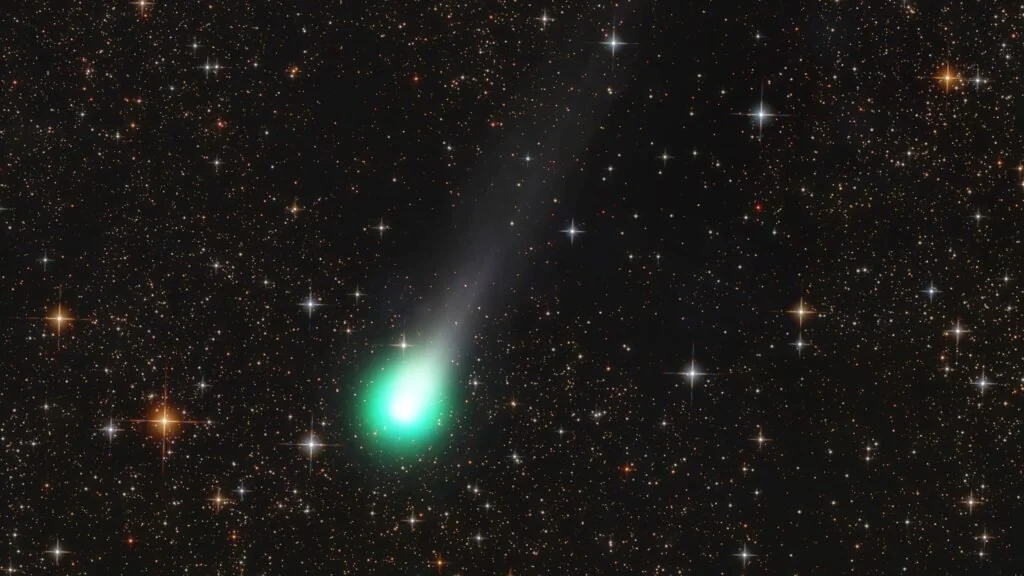
The cosmos is offering an unprecedented celestial show, as two comets, Lemmon (C/2025 A6) and SWAN (C/2025 R2), reach their closest and brightest points in the night sky. This rare occurrence provides amateur astronomers with a unique opportunity to observe these icy visitors from our solar system.
Approaching Comets: Lemmon and SWAN
In October, Comet Lemmon (C/2025 A6) will make its closest approach to Earth on Tuesday, October 21. According to SpaceWeather.com, the comet is expected to shine at magnitude 4.5, making it visible in very dark skies and requiring binoculars for optimal viewing. The comet’s path through the sky can be traced by following the shape of stars in the Big Dipper’s handle to “arc to Arcturus.” By Tuesday evening, Comet Lemmon will be a little higher in the northwest sky.
Meanwhile, Comet SWAN (C/2025 R2), although fainter at magnitude 5.9, will get its closest approach to Earth on Monday, October 20. This comet can also be observed with binoculars or a telescope by looking for it about halfway between the bright star Altair and the horizon in the southwest sky.
Observing Tips: Best Time and Locations
The best time to observe both comets any night this week is approximately an hour and a half after sunset. For accurate local times, you can check websites like Timeanddate.com. Detailed finder charts and sky maps are available at various online resources such as The Sky Live, In-The-Sky.org, and Stellarium, as well as in night-sky apps like Sky Guide, Sky Tonight, and SkySafari 7 Pro.
Comet Lemmon’s journey through the solar system is part of its 1,350-year orbit.
However, Jupiter has slightly altered its path, reducing its return period to about 209 years instead of 1,550 years. Comet SWAN, on the other hand, is a long-period comet with an orbital period of around 20,000 years.
Future Implications and Expert Perspectives
Astronomers suggest that these cometary visitors provide valuable insights into the formation and evolution of our solar system. According to Jamie Carter, Live Science contributor: “The closer approach of Comet Lemmon and the fainter but still visible Comet SWAN offers amateur astronomers a rare opportunity to observe these icy bodies with their own eyes.” He adds, “Both comets are on vastly different journeys, making this an exciting time for stargazers.”
With these comets gracing our skies, it’s not just about the beauty but also the science. As more and more people take to the skies to observe these celestial bodies, they contribute to ongoing research in astronomy, helping scientists understand the origins of our solar system and the mysteries that lie beyond.
The next time you look up at the night sky, remember: These comets are not just fleeting guests but also gateways to understanding the cosmos. Happy stargazing!