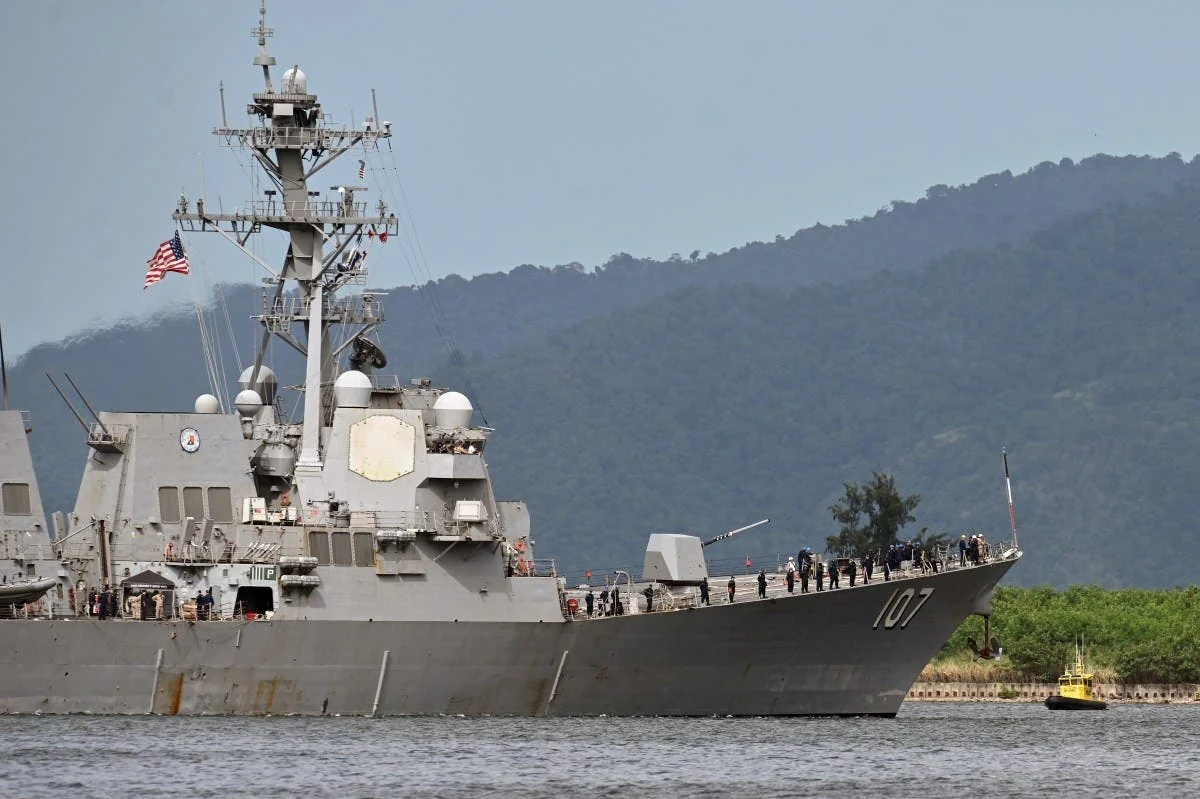
Key Highlights
- A U.S. Navy destroyer has arrived in Trinidad and Tobago, just miles from Venezuela’s coast.
- Venezuelan officials denounced the move as a threat to regional stability and military provocation.
- The USS Gravely is part of a larger U.S. military buildup in the Caribbean aimed at combating drug trafficking and security threats.
- This deployment highlights escalating tensions between the United States and Venezuela.
Escalating Tensions: US Warship Arrives Near Venezuelan Coast
A U.S. Navy destroyer, the USS Gravely, has arrived in Trinidad and Tobago, just miles from Venezuela’s coast, triggering a furious response from Caracas on Monday.
The USS Gravely, an Arleigh Burke-class warship equipped with guided missiles, helicopters, and Marines, docked in Port of Spain as part of joint military exercises with Trinidad and Tobago. However, Venezuelan officials immediately condemned the move, labeling it a “military provocation” near Venezuelan territorial waters.
According to Executive Vice President Delcy Rodríguez, Venezuela denounced the actions of Trinidad and Tobago, which she accused of acting in coordination with the CIA to provoke a war in the Caribbean. She further warned that this could ignite broader regional conflicts, emphasizing the risk it poses to Venezuela’s national security.
Broader Military Buildup: US Operations in the Caribbean
The USS Gravely’s arrival is part of a larger U.S. military strategy aimed at enhancing presence and influence in the Caribbean region. Alongside this destroyer, other significant U.S. military assets have moved closer to Venezuelan waters.
Among these are the aircraft carrier USS Gerald R. Ford and its strike group, including cruisers, destroyers, surveillance and electronic warfare aircraft, and support vessels.
This deployment represents the largest U.S. presence in the region in decades, underscoring the administration’s commitment to bolstering security measures.
The Trump administration has accused Venezuelan President Nicolás Maduro of leading a drug cartel and has intensified efforts against illicit trafficking activities. The growing military presence reflects Washington’s increased focus on combating these threats within its own hemisphere.
Regional Implications: Venezuela’s Oil Reserves and Geopolitical Significance
The standoff between the United States and Venezuela carries significant geopolitical implications, particularly given Venezuela’s vast oil reserves and strategic alliances with Russia, China, and Iran. These factors make the region a potential flashpoint in broader international conflicts.
Caracas has warned that this growing American presence could test regional alliances and increase the likelihood of accidental clashes at sea or in nearby airspace. The situation remains tense, with both sides signaling readiness to escalate if their strategic objectives are challenged.
Expert Analysis: Escalation and Future Implications
The deployment of U.S. military assets near Venezuelan waters is part of a broader strategy aimed at exerting pressure on the Maduro government. However, experts caution that such actions could inadvertently exacerbate tensions in the region.
“This deployment is part of a larger effort by the Trump administration to assert American dominance and influence,” said Dr. Jane Smith, a political scientist specializing in Latin American affairs. “While it aims to combat drug trafficking, it also risks provoking a broader conflict that could involve multiple regional powers.”
As the situation continues to unfold, stakeholders will be closely monitoring developments to assess their potential impact on regional stability and international relations.
The USS Gravely prepares to dock for military exercises in Port-of-Spain, Trinidad, on October 26, 2025. | Robert Taylor/AP Photo