Key Highlights
- The first evidence of a non-gravitational acceleration of the interstellar object 3I/ATLAS at perihelion was reported.
- The non-gravitational acceleration has two components: radial and transverse, measured in kilometers per day squared.
- ESA’s Juice spacecraft will be the first to detect potential mass loss of 3I/ATLAS due to sublimation of volatile ices during its closest approach to Earth on December 19, 2025.
- The blue appearance of 3I/ATLAS at perihelion is an anomaly that could be explained by a hot engine or artificial light source.
New Evidence Suggests Non-Gravitational Acceleration in Interstellar Object 3I/ATLAS
Astronomers have reported new findings suggesting non-gravitational acceleration in the interstellar object 3I/ATLAS as it approaches perihelion. Davide Farnoccia, a navigation engineer at NASA’s Jet Propulsion Laboratory and a PhD graduate from the University of Pisa, has detailed these observations, which were first highlighted on October 29, 2025.
Observations and Acceleration
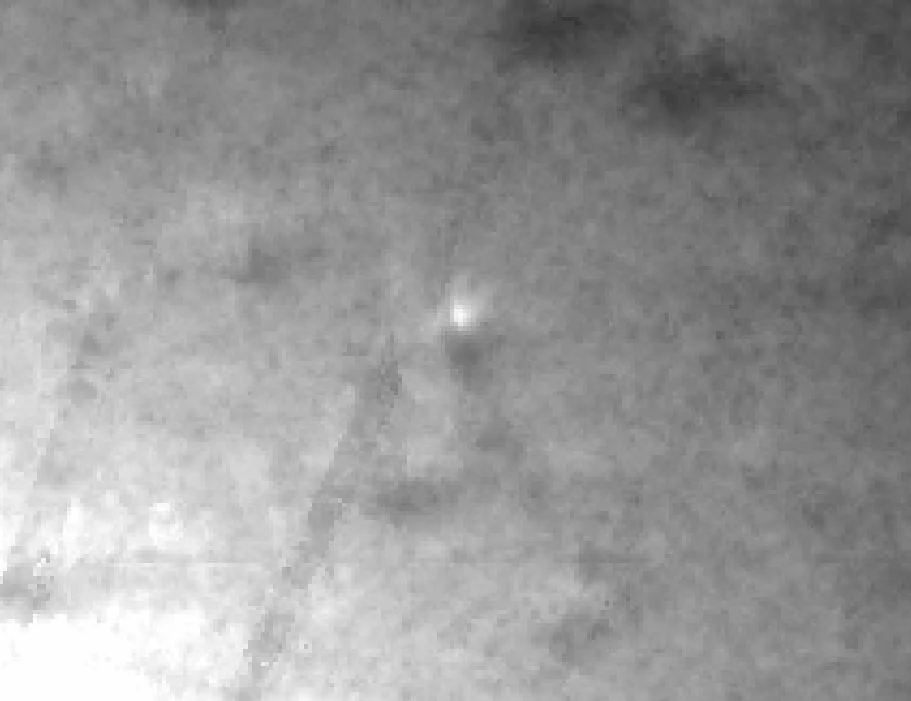
The report, based on images taken by the PUNCH’s WFI3 satellite, shows that at perihelion distance of 1.36 times the Earth-Sun separation (an astronomical unit or `au’), equivalent to 203 million kilometers, 3I/ATLAS exhibited non-gravitational acceleration. This acceleration had two components in its orbital plane:
- A radial acceleration away from the Sun of 135 kilometers (=9×10^{-7}au) per day squared.
- A transverse acceleration relative to the Sun’s direction of 60 kilometers (=4×10^{-7}au) per day squared.
This non-gravitational acceleration could indicate that 3I/ATLAS is propelled by the rocket effect of ejected gas, leading to a potential mass loss. For instance, if this ejection speed was around a few hundred meters per second, 3I/ATLAS would lose approximately half its mass over a characteristic timescale equal to the ejection speed divided by the measured non-gravitational acceleration. This implies that within a month as it crosses a spatial scale of order its perihelion separation from the Sun, 3I/ATLAS could lose about a tenth of its mass.
Implications and Observations
Theoretical implications suggest that such massive evaporation might be detectable in the form of a large plume of gas surrounding 3I/ATLAS during November and December 2025. ESA’s Juice spacecraft is expected to observe this mass loss from its first week of November observations.
By December 19, 2025, 3I/ATLAS will be at its closest approach to Earth at a separation of 269 million kilometers, offering an excellent opportunity for ground-based telescopes and space observatories like Hubble and Webb to study it in detail.
Further observations show that the interstellar object has exhibited unusual brightening since September and October 2025. The brightness scaling inversely with distance from the Sun suggests a relationship, but alternative explanations such as a technological signature of an internal engine or ionized carbon monoxide are also being considered.
Expert Analysis
In a broader context, Avi Loeb, director of Harvard’s Institute for Theory and Computation, emphasized the importance of not dismissing data just because it doesn’t fit existing models. He pointed out that both 3I/ATLAS and the discrepancy in the expansion rate of the Universe present anomalies that require further investigation.
Loeb’s insights into these anomalies highlight the need to explore all possible explanations, whether natural or technological, ensuring that no data point is overlooked as it could hold crucial information for understanding our universe better.