Key Highlights
- The anti-tail of interstellar object 3I/ATLAS turned into a tail as it approached the Sun.
- A study by Avi Loeb and Eric Keto explains this transition using high-resolution imaging data.
- Mass loss from 3I/ATLAS is consistent with carbon dioxide (CO2) being the main driver of activity.
- The transition could indicate controlled maneuvering, suggesting a possible technosignature.
The Mysterious Transition: From Anti-tail to Tail in 3I/ATLAS
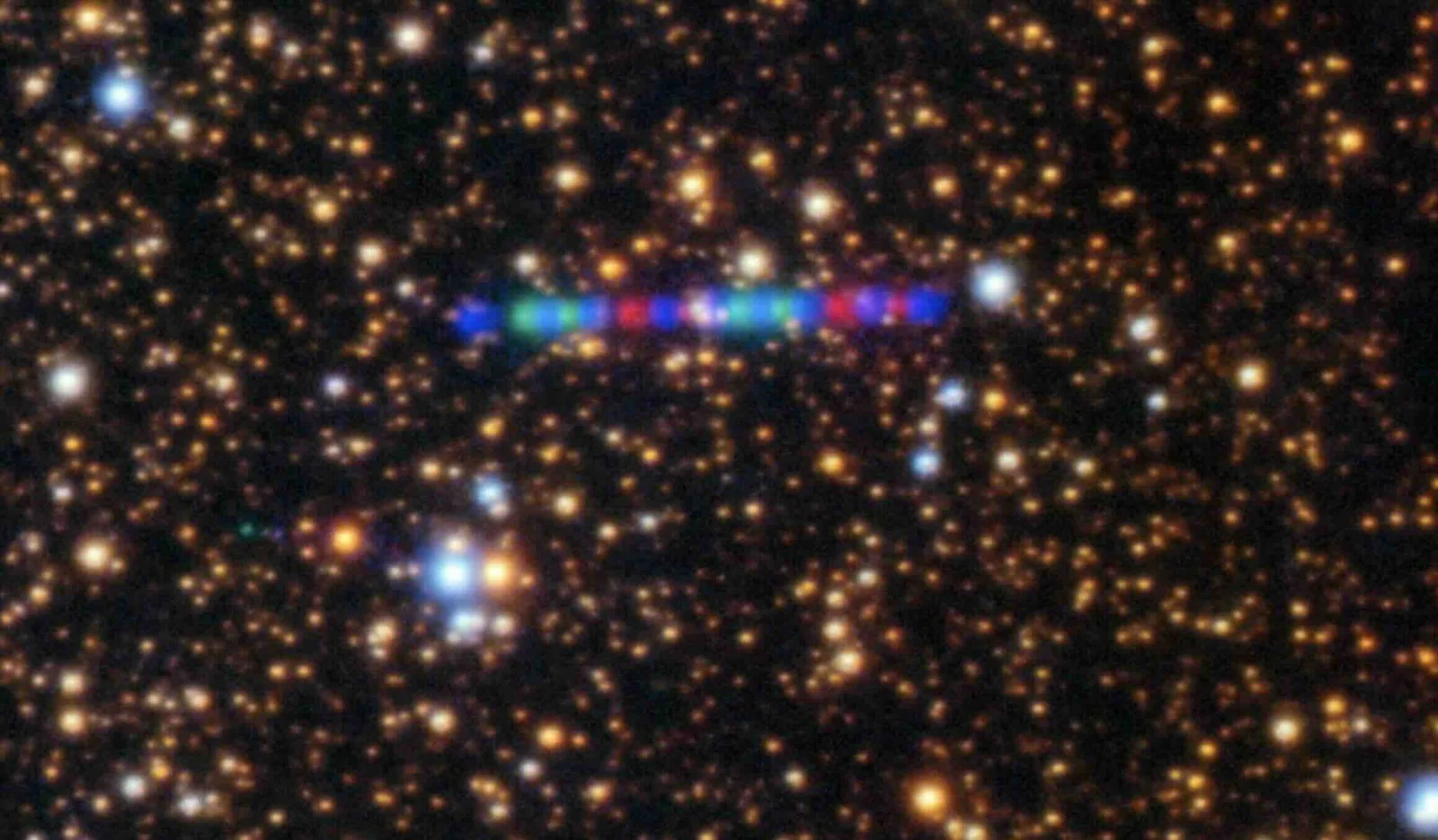
Recent observations of the interstellar object (ISO) 3I/ATLAS have revealed an intriguing transformation. Initially observed as having a pronounced anti-tail, which appeared to be directed towards the Sun, new images from the Nordic Optical Telescope now show this phenomenon has reversed into a tail stretching away from the Sun.
This transition is significant because it aligns with predictions made by Avi Loeb and Eric Keto, who have developed a detailed theoretical model explaining the change. According to their research, as 3I/ATLAS approaches the Sun, the sublimation rate of ice fragments increases exponentially due to temperature changes, leading to a decrease in their residence time in the outflow.
Understanding the Mass Loss and Activity
The mass loss from 3I/ATLAS has been estimated at about 150 kilograms per second during its closest approach to the Sun. This rate is consistent with carbon dioxide (CO2) being the primary driver of activity, as previously inferred by spectroscopic data collected by the SPHEREx space observatory and the Webb Space Telescope.
High-resolution images taken on July 21, 2025, using the Hubble Space Telescope revealed a pronounced sunward anti-tail with a projected elongation ratio of 2:1. This suggests that the activity is dominated by scattering of sunlight by H2O ice fragments ejected from the nucleus as CO2 sublimates.
Implications and Technosignature Possibilities
The transition from an anti-tail to a tail could be indicative of controlled maneuvering, which would constitute a technosignature. As 3I/ATLAS approaches perihelion (the closest point to the Sun), it will face intense solar radiation, estimated at over 33 gigawatts on its surface.
Post-perihelion observations are critical for determining the true nature of 3I/ATLAS. If it exhibits characteristics similar to a natural comet, Avi Loeb’s ranking system may be adjusted, but his colleague Adam Hibberd suggests that if 3I/ATLAS is an alien spacecraft, this change would indicate controlled maneuvering and possibly an attempt to achieve a bound heliocentric orbit between Mars and Jupiter.
The most important clues about its nature will come from post-perihelion observations, which are scheduled for December 19, 2025. These observations could provide definitive answers as to whether the object is natural or artificial, marking a significant moment in astrophysics research.