Key Highlights
- Easter Island’s giant moai statues could “walk” with only three things in place: a small group of people, long ropes and the use of pendulum dynamics.
- A new study finds that physics was on their side when moving these massive human-faced statues from the quarry to ceremonial positions.
- The experiments revealed that using rope and a small group of people, the Rapa Nui could have “walked” the moai up to 1,000 feet per hour.
- Archaeologists suggest this method was remarkably efficient, requiring only 15 to 60 people to start the movement and five to 25 to continue it.
The Intriguing History of Easter Island’s Moai Statues
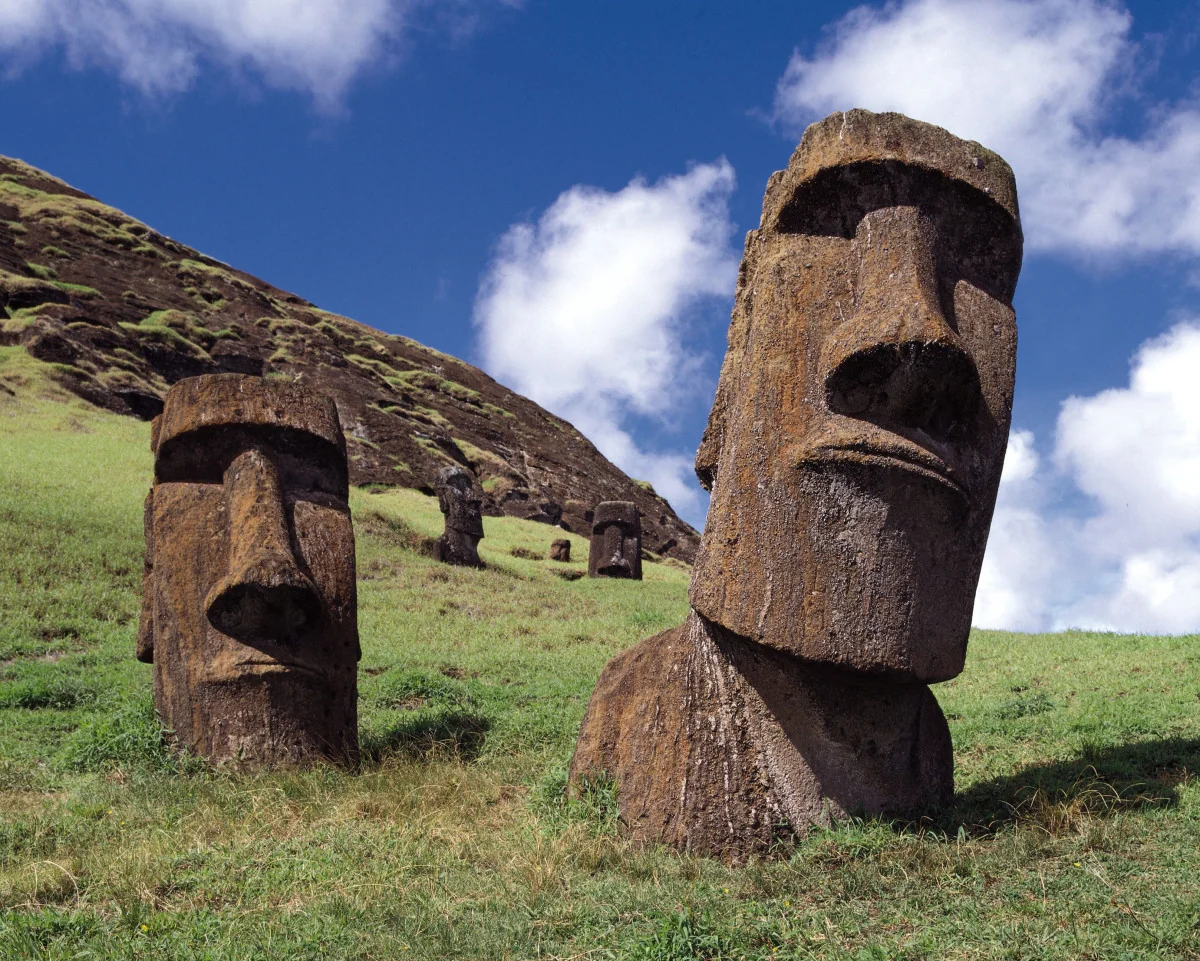
Easter Island, also known as Rapa Nui, is a Polynesian island in the southeastern Pacific Ocean. It is famous for its monumental stone statues called moai. The island’s history dates back around 1,000 years, when it was first settled by the indigenous Rapa Nui people. Over time, these inhabitants carved thousands of massive human-faced statues that now stand as a testament to their ancient culture.
Unraveling the Mystery of Moai Transport
The transportation of moai has long been a subject of debate among archaeologists and historians. Early theories suggested that vast amounts of resources and large numbers of people were needed to move these statues, which can weigh dozens of tons on average. However, new research challenges this conventional view, proposing an ingenious method involving simple physics principles.
Key Findings from the Study
In a groundbreaking study published in the Journal of Archaeological Science, anthropologists Carl Lipo and Terry Hunt revealed that the Rapa Nui people could have “walked” their moai statues using only three essential elements: a small group of individuals, long ropes, and pendulum dynamics. Their research was based on experiments and virtual 3D modeling of the road moai found along old ceremonial paths.
The team discovered that incomplete moai sculptures, which were discarded shortly after being carved from volcanic rock, had distinctive features such as a forward lean and a low center of mass. This design facilitated the movement by shifting the statue’s balance to allow for sideways rocking, mimicking a walking motion.
Experimental Evidence
To test their hypothesis, Lipo and Hunt conducted experiments with scaled-down replicas of moai statues. They found that 15 to 60 people were needed initially to initiate the “walking” movement, while five to 25 people could maintain it. The average speed was calculated at around 1,000 feet per hour (310 meters).
Using long ropes, participants would apply force in a rocking motion that caused the base of the moai to pivot and step forward. Once initiated, this process became less effortful due to pendulum dynamics, allowing for more efficient transportation over longer distances.
Implications for Archaeology
The findings from Lipo and Hunt’s study offer compelling evidence against previous theories that required extensive resources and large labor forces to transport the moai. Instead, their research suggests a much simpler and more efficient method involving physics principles understood by ancient Rapa Nui people.
However, some archaeologists remain skeptical, pointing out that other factors such as different engineering practices for road versus ceremonial statues could have influenced the results. Nevertheless, this study provides valuable insights into the innovative techniques employed by the indigenous inhabitants of Easter Island to achieve monumental feats of stone carving and transportation.