Key Highlights
- New research suggests that Rapa Nui people may have “walked” their moai statues upright.
- The technique involves using two teams to tug on ropes while a third ensures stability, making it easier than previously thought.
- Archaeological evidence supports the walking hypothesis and challenges conventional theories of horizontal transport.
- This finding highlights the ingenuity of ancient Polynesian people in transporting these massive statues efficiently.
New Evidence Suggests Moai Statues Walked to Their Locations
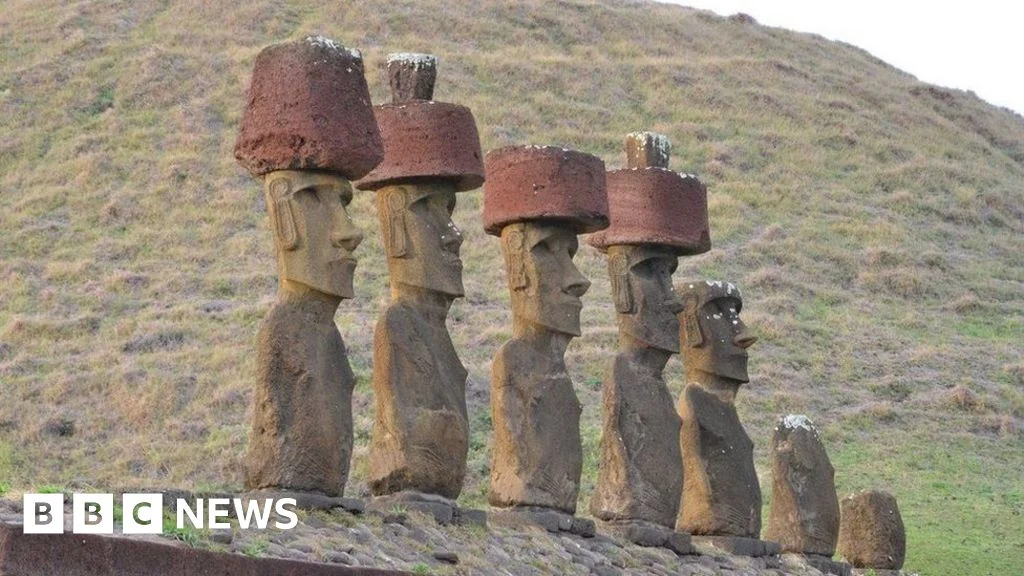
Easter Island’s enigmatic moai statues, some weighing several tons, may have walked to their current positions on the remote Rapa Nui island in the South Pacific. This groundbreaking theory challenges previous assumptions about how these iconic artifacts were transported.
The Walking Moai Hypothesis
In 2012, a research team led by Carl Lipo from Binghamton University successfully demonstrated that a 4.35-ton replica of a moai could be “walked” using the same technique used by the Rapa Nui people. This method involves two teams pulling on ropes in opposite directions to teeter the statue forward while a third team prevents it from toppling over.
Lipo and his team recently published findings showing that 51.6 percent of the moai statues were concentrated within 2 km of their quarry origins, suggesting mechanical failure rather than deliberate placement. This distribution pattern aligns with the walking hypothesis, which posits that once in motion, moai required minimal effort to transport.
Archaeological Evidence and Expert Analysis
The D-shaped base and forward-leaning design of many moai optimize them for this upright movement. Statues abandoned along ancient roads were found to have imbalanced centers of gravity, indicating they had toppled during transport. Additionally, the narrow 4.5-meter-wide ro (ancient roadways) with slightly concave cross-sections provided ideal conditions to stabilize and guide the statues.
According to Lipo, “Once the moai are in motion, it’s not at all difficult.” This method requires less labor and materials compared to horizontal transport theories. The study emphasizes the ingenuity of ancient Polynesian people in engineering such a practical solution for moving these massive monuments.
Finding Modern Relevance
The walking moai theory challenges conventional ideas about ancient transportation methods, offering insights into the efficiency of early human engineering. Lipo notes that modern man has much to learn from this ancient feat, highlighting how complex engineering solutions can be achieved with simpler means.
This research not only sheds light on Easter Island’s rich history but also serves as a testament to the ingenuity and problem-solving skills of its inhabitants. As we continue to explore archaeological sites around the world, similar innovative techniques may yet be uncovered, challenging our perceptions of ancient civilizations.