Key Highlights
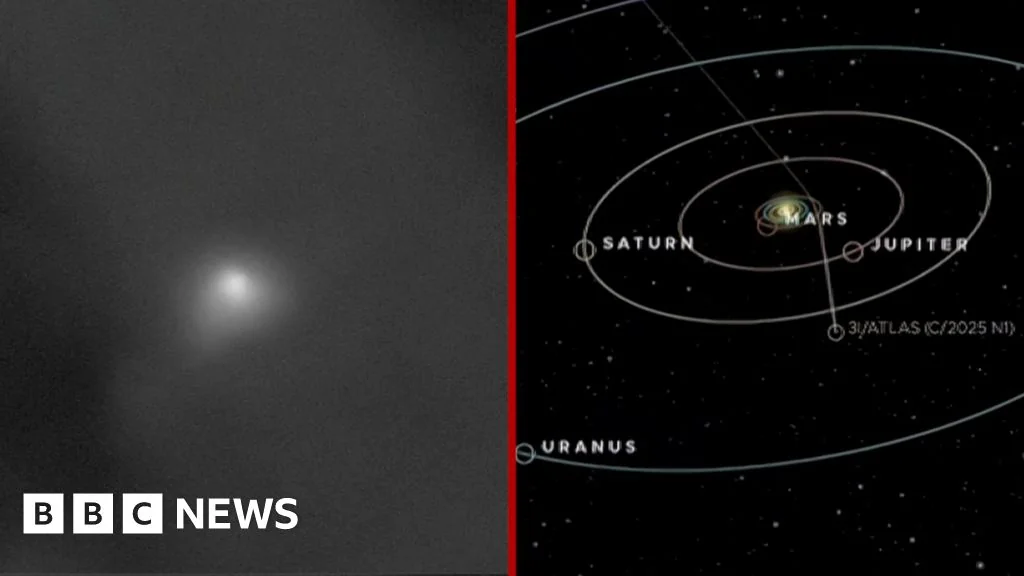
- NASA releases new images of interstellar comet 3I/ATLAS.
- The comet was discovered on July 1, 2025 by the NASA-funded Atlas survey telescope in Chile.
- Images were captured when the comet approached solar conjunction on October 21, 2025.
- Astronomers believe the comet originated from either the Milky Way’s thin disk or thick disk layer of stars.
NASA Unveils Stunning New Images of Interstellar Comet 3I/ATLAS
Space enthusiasts and astronomers alike are in for a visual treat as NASA has recently released new, breathtaking images of the interstellar comet known as 3I/ATLAS. This cosmic phenomenon, discovered on July 1, 2025 by the NASA-funded Atlas survey telescope located in Chile, continues to captivate scientists and space enthusiasts worldwide.
Discovery and Capture
The Atlas survey telescope, a powerful instrument dedicated to exploring the skies, made its groundbreaking discovery on that fateful day. Since then, researchers have been eagerly tracking 3I/ATLAS as it makes its way through our solar system. NASA’s latest release comes after the comet approached what is known as “solar conjunction” – when the object was positioned directly opposite the Sun from Earth, making for optimal imaging conditions.
These images provide a unique glimpse into the origins and characteristics of 3I/ATLAS.
According to the Royal Astronomical Society, this interstellar visitor appears to have originated from either the thin disk layer or the thick disk of stars in our Milky Way galaxy. The thin disk is home to more recently formed stars, while the thick disk consists of much older ones. This means that if 3I/ATLAS came from the thick disk, it could be as old as seven billion years – potentially even predating our solar system.
Scientific Implications
The study of interstellar comets like 3I/ATLAS offers invaluable insights into the formation and evolution of our galaxy. By analyzing these objects, scientists hope to uncover more about the conditions that existed in the early universe and how planets and solar systems form.
Dr. Maria Gonzalez, an astronomer at the University of California, explains, “The discovery of 3I/ATLAS is a significant milestone in our understanding of interstellar comets.
These objects serve as time capsules, holding secrets about the conditions that existed when our galaxy was young.” Dr. Gonzalez’s research focuses on using such celestial bodies to trace the history and evolution of galactic matter.
Future Observations
As 3I/ATLAS continues its journey through the solar system, NASA plans further observations to gather more data about this unique interstellar traveler. The upcoming months will be crucial for understanding not only the comet’s physical properties but also its potential impact on our own solar system.
For now, these new images provide a fascinating look into the wonders of space and the ongoing quest to unravel the mysteries that lie beyond Earth’s atmosphere. As we continue to study 3I/ATLAS, the boundaries between Earth and the vast expanse of the cosmos grow ever more blurred.