Key Highlights
- The US Justice Department is suing California over new congressional maps.
- The new voting maps favor Democrats and are seen as canceling out Republican gains in Texas.
- Attorney General Pam Bondi accused Governor Gavin Newsom of a “brazen” power grab using racially gerrymandered maps.
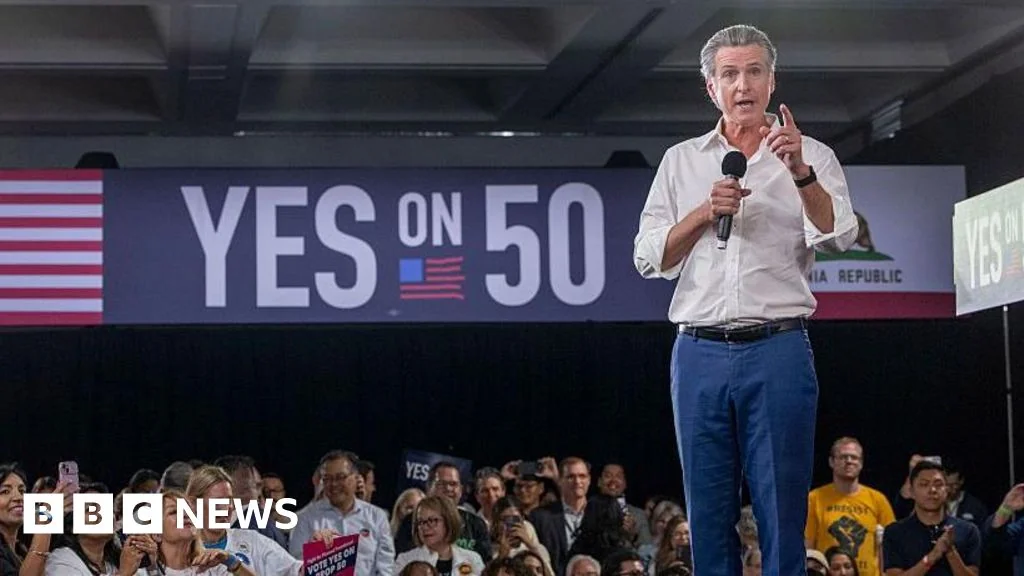
- California voters approved Proposition 50, giving Democrats an advantage in five new congressional districts.
Background on the Redistricting Issue
The US Justice Department has filed a lawsuit against California over the state’s newly approved redistricting maps, which were enacted through a ballot initiative known as Proposition 50. The maps are part of broader efforts by President Donald Trump to influence the 2026 midterm elections in favor of his Republican Party.
California voters overwhelmingly supported this measure, with a significant majority approving it last week. However, the federal government views these changes as unconstitutional due to their alleged racial gerrymandering.
Contention and Legal Basis
In its complaint filed in a California federal court on Thursday, the Justice Department claims that Governor Gavin Newsom and Secretary of State Shirley Weber have mandated “racially gerrymandered congressional districts,” violating the Equal Protection Clause of the 14th Amendment to the US Constitution.
Jesus A Osete, Principal Deputy Assistant Attorney General for Civil Rights, stated, “Race cannot be used as a proxy to advance political interests, but that is precisely what the California General Assembly did with Prop 50.” He further emphasized that these maps are illegal and will not be allowed beyond 2026.
Context of Redistricting Efforts
The redistricting dispute between federal authorities and state officials reflects a broader political struggle over electoral control. President Trump initiated nationwide redistricting efforts to ensure Republican majorities in the US House of Representatives during the 2026 midterm elections.
Attorney General Rob Bonta, defending Newsom’s actions, noted that several legal challenges against Proposition 50 have already been brought and none have prevailed. “Californians spoke loud and clear,” he said, adding, “They are sick and tired of Trump’s lawlessness, of his lies, and of his inability to make life more affordable for all Americans.” Bonta contended that the federal government is seeking to intervene in ongoing litigation.
Expert Analysis
The case of California versus the US Justice Department highlights the complex interplay between state and federal powers. Legal experts have pointed out that while redistricting can be influenced by race, it must not violate constitutional protections against discrimination.
“Gerrymandering is a legal process when done without racial considerations,” explained Professor Lisa Gaspar of Stanford University. “The challenge here lies in proving that the maps were drawn primarily for political gain and not for legitimate representation concerns.”
Implications and Future Outlook
The outcome of this lawsuit could have far-reaching implications for both California’s governance structure and the national balance of power. If the federal courts rule in favor of the Justice Department, it may set a precedent that restricts states’ ability to redraw voting maps based on race.
Newsom’s campaign to suspend independently drawn maps reflects his strategy to counteract Republican efforts in Texas. However, this approach has also opened him up to legal challenges and federal scrutiny.
The ongoing battle over redistricting in California is emblematic of larger political tensions and the delicate balance between state autonomy and federal oversight in American democracy.