Key Highlights
- California voters approved a map for congressional districts that could help Democrats win five more seats in the U.S. House.
- The move by California is part of a broader redistricting race initiated by President Trump to reshape voting maps in favor of Republicans.
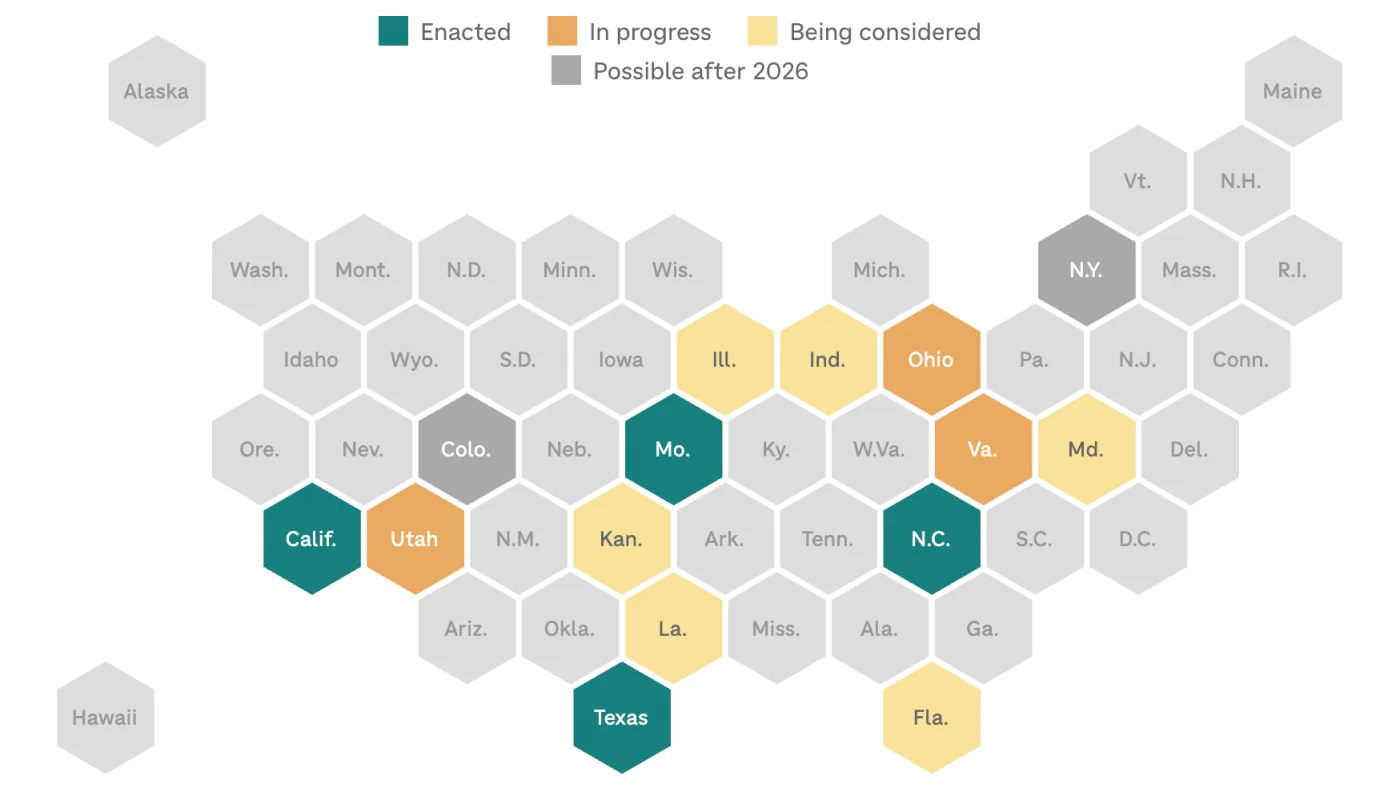
- So far, the GOP has gained an edge in Texas, Missouri, North Carolina, and Ohio, with potential gains in Indiana, Kansas, Florida, or Louisiana.
- Democrats have tilted five seats their way in California, with a sixth seat in Utah likely to shift towards Democrats.
The Battle for Redistricting Control
Following the recent vote by California voters to counter President Trump’s efforts at reshaping voting maps, the state now finds itself positioned as one of the key battlegrounds in the ongoing redistricting battle. This development marks a significant move that could influence the outcome of the 2026 midterm elections.
President Trump has been actively pushing for states to redraw their congressional districts in favor of his party, aiming to maintain or expand the Republican advantage in the U.S. House. This effort is part of a broader strategy to protect Republicans from potential investigations by a Democratic-led House and to continue advancing his political agenda.
California’s Move: A Strong Democratic Push
California voters overwhelmingly approved a map for congressional districts that could help Democrats gain an additional five seats in the U.S. House. This decision was made through Proposition 50, which aimed to sidestep the existing redistricting commission and draw new lines directly.
The approval of this map is significant as it represents one of the most substantial Democratic moves against Trump’s efforts to reshape voting maps in favor of Republicans. It highlights the growing tension between the two parties over control of electoral districts, which can significantly influence the outcome of elections.
Redistricting Race Across the Country
The redistricting race is not limited to California alone. President Trump has encouraged Republican leaders across the country to draw new lines that favor his party in the 2026 midterm elections. As a result, several states are already seeing shifts in political control through their newly drawn district maps.
In Texas, for instance, Republicans have managed to gain an edge in five seats, with potential gains also being seen in Missouri, North Carolina, and Ohio.
If successful, these efforts could result in the GOP picking up nine or so seats in the midterms next year, with additional potential gains of four or five if more states follow suit.
However, this scenario is not set in stone. Court challenges and other factors could alter the outcome significantly. For example, a Texas judge is currently considering a case related to redistricting efforts there, while Republicans have also sued in California over the new district maps.
Democratic-led States: Limited Options
While Democrats have fewer options compared to Republicans due to their limited control of legislatures, several states are still taking steps towards potential redistricting. In Virginia, Democratic lawmakers have started a process that could result in flipping two or three seats. Maryland and Illinois might also add one seat each, although Democrats haven’t decided on this yet.
California’s decision to sidestep the existing commission and directly engage voters is unique but represents a significant shift. It shows how critical redistricting can be in determining election outcomes and highlights the ongoing struggle between political parties over control of electoral maps.
The Implications of Redistricting
Redistricting plays a crucial role in shaping the composition of the U.S. House, with significant implications for policy making and governance. The current redistricting race underscores the importance of these processes in determining political power at both state and national levels.
As states continue to grapple with how best to draw their district maps, it is clear that this issue will remain a contentious one well into the future.
Whether through direct voter approval or legislative action, the outcome of redistricting efforts could shape the course of American politics for years to come.
- California voters approved a map for congressional districts that could help Democrats win five more seats in the U.S. House.
- The move by California is part of a broader redistricting race initiated by President Trump to reshape voting maps in favor of Republicans.
- So far, the GOP has gained an edge in Texas, Missouri, North Carolina, and Ohio, with potential gains in Indiana, Kansas, Florida, or Louisiana.
- Democrats have tilted five seats their way in California, with a sixth seat in Utah likely to shift towards Democrats.
Note: The timeline and details provided are as of November 6, 2025. Further developments may impact the final outcome of the redistricting race across the country.