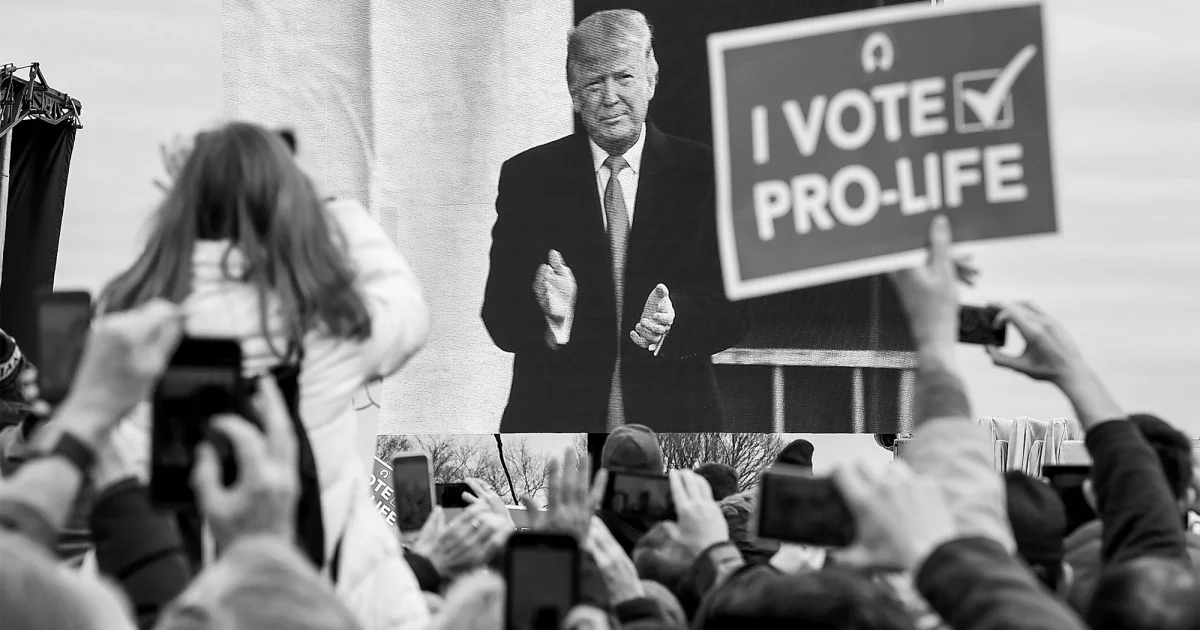
- President Donald Trump suggested flexibility on the Hyde Amendment during a policy retreat, potentially compromising conservative principles.
- Anti-abortion leaders criticized Trump’s remarks, warning of political fallout in midterm elections if he were to backtrack on Hyde.
- The Trump administration has taken limited action regarding abortion policies, focusing more on trans rights issues that align with conservative voters’ priorities.
- Abortion opponents have continued legal challenges at state and federal levels, seeking to force policy changes despite lack of action from the administration.
The Abortion Policy Landscape under Trump’s Administration
In a significant move that landed with a punch on his far-right coalition, President Donald Trump suggested flexibility on the Hyde Amendment during a policy retreat. The Hyde Amendment, in effect for 50 years, prohibits the use of federal funds for abortion services. This suggestion came as House Republicans had allowed subsidies under the Affordable Care Act to expire in December, leading to skyrocketing insurance premiums and an election-year backlash.
Trump urged GOP lawmakers to compromise with Democrats on resurrecting these subsidies, even if it meant compromising a bedrock conservative principle. “You gotta work something,” he told them from the Kennedy Center stage during their policy retreat. “You gotta use ingenuity.”
Backlash and Political Consequences
The suggestion was met with outrage among anti-abortion leaders. They warned that any backtracking on the Hyde Amendment would be a “massive betrayal” and could lead to significant political damage in midterm elections if they were demoralized by Trump’s remarks. According to a leading anti-abortion strategist quoted in Politico, “If you demoralize a small percentage of pro-lifers, even if it is only 2 percent of the total electorate in swing districts, that is devastation.”
The Administration’s Approach to Abortion Policies
A year into his term, Trump’s approach to abortion has been more of a slow walk than shock and awe. While he has managed to score some victories through legal challenges, such as reinstating the global gag rule and banning abortion services for veterans, he has not taken significant steps towards restricting federal funding for abortions. The administration has also failed to rescind FDA rules that make abortion pills widely accessible across the US.
Despite the limited actions, abortion opponents have continued pressing legal challenges at both state and federal levels, hoping conservative judges will force policy changes. Mary Ziegler, a law professor at the University of California, Davis, who has extensively studied the conservative Christian legal movement, notes that “left to his own devices, Trump might just run out the clock on abortion stuff for the entirety of his presidency.” However, she cautions that he is not left to his own devices and that these challenges could force him into action.
Compromises on Trans Rights Issues
In contrast, Trump has been more aggressive in attacking trans rights, an issue that aligns with the priorities of social conservatives. This approach has allowed him to cater to conservative voters without immediate political cost, unlike his lackluster actions on abortion.
Key Players and Their Impact
The role of Roger Severino, a powerful figure in the anti-abortion movement who was not included in Trump’s second-term administration, highlights the disappointment among conservative groups. Similarly, the approval of another generic version of mifepristone by the FDA in October surprised many, as it seemed to run contrary to the administration’s stance on reproductive health issues.
Despite these challenges, abortion opponents continue their legal and legislative efforts, leaving the issue hanging in a state of uncertainty. As Ziegler notes, “We’re now at a point where there are a bunch of loaded guns lying around on tables, and we don’t know what’s going to happen. This is sort of like a Russian roulette moment.”