Key Highlights
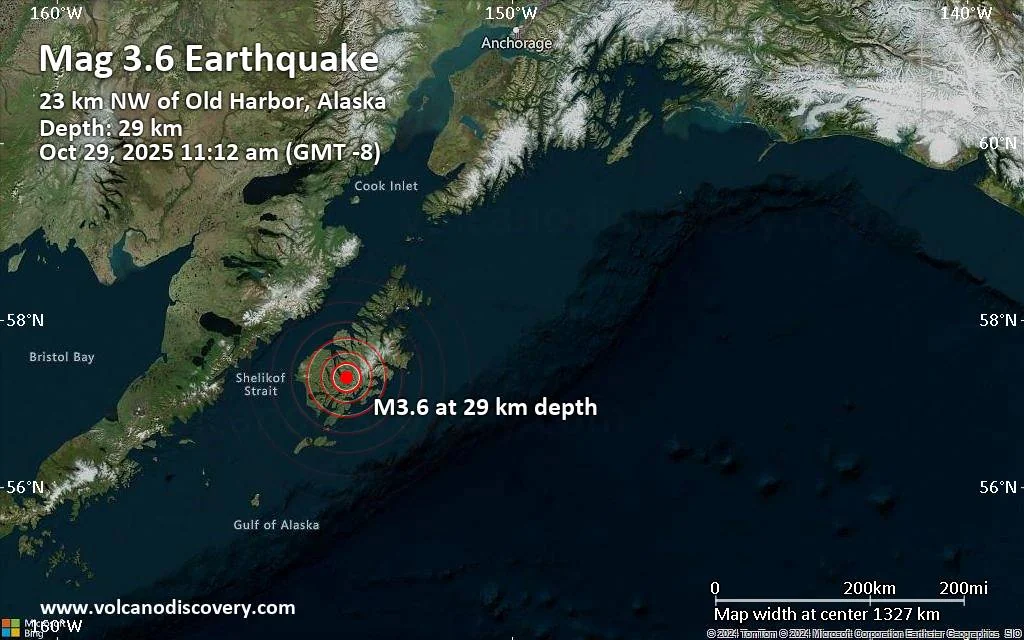
- A small magnitude 3.6 earthquake struck near Kodiak, Alaska, on Wednesday, October 29th, 2025.
- The quake was reported by the United States Geological Survey (USGS) at 11:12 am local time.
- Shallow earthquakes are felt more strongly than deeper ones due to their proximity to the surface.
- The European-Mediterranean Seismological Centre (EMSC) reported the same quake as a magnitude 3.6 earthquake.
Quake Details and Impact on Local Communities
A small yet notable seismic event occurred in Alaska, specifically 56 miles southwest of Kodiak, on Wednesday, October 29th, 2025. The magnitude 3.6 earthquake was recorded at 11:12 am local time by the United States Geological Survey (USGS). This shallow earthquake is significant due to its proximity to the surface, making it feel more intense than deeper quakes.
The seismic activity affected several nearby towns and cities.
Old Harbor, a small town with a population of 220 residents located approximately 15 miles from the epicenter, reported feeling very weak shaking. Similar reports came from Larsen Bay (population: 88), situated about 20 miles away, and Akhiok (population: 72) at a distance of around 33 miles.
Impact on Larger Communities
Communities closer to the epicenter like Karluk (population: 37) experienced no significant effects. Similarly, Womens Bay (population: 720), Port Lions (population: 200), and Kodiak Station (population: 1,300) also reported no noticeable shaking. The larger city of Kodiak, with a population of 6,300, was not affected by the earthquake.
Seismic Activity in Other Parts of the World
The global seismic activity on October 29th, 2025, saw multiple earthquakes reported across different regions. For instance, a magnitude 2.8 quake occurred near Spittal an der Drau in Austria and a magnitude 3.6 earthquake struck only 10 miles west of Lockhart River, Queensland, Australia. Additionally, a significant magnitude 4.7 earthquake was reported near Jayapura, Papua, Indonesia, at 6:57 am local time.
These events underscore the ongoing global seismic activity observed by various seismological centers and agencies like USGS, EMSC, and IRIS, which continue to monitor and report on such occurrences. The data from these agencies help in understanding the distribution and intensity of quakes, contributing to better preparedness for potential natural disasters.
Conclusion
The small magnitude 3.6 earthquake near Kodiak, Alaska, highlights the continuous seismic activity observed globally. While such events may not cause significant damage, they serve as reminders of the importance of monitoring and understanding geological phenomena. The reports from multiple agencies ensure accurate information dissemination, aiding in public awareness and preparedness for future earthquakes.