Key Highlights
- The RECOVER-Adult US cohort identified eight distinct longitudinal trajectories of Long COVID symptom burden.
- About 195 participants (5%) had persistently high Long COVID symptoms, and 443 (12%) had non-resolving, intermittently high symptoms.
- Of the 377 participants who met Long COVID criteria at three months, 46% were in persistent Long COVID, 35% continued to have intermittent symptoms, and 19% showed improvement over time.
- The study highlights the need for targeted enrollment strategies for future investigations into pathogenesis and treatment of Long COVID.
Introduction to Long COVID Trajectories in RECOVER-Adult Cohort
Long COVID, a chronic condition following SARS-CoV-2 infection, remains poorly understood despite its widespread impact. A recent study by the National Institutes of Health Researching COVID to Enhance Recovery (RECOVER) Adult Cohort provides critical insights into Long COVID trajectories among 3,659 participants, including demographic and clinical characteristics that could inform future research and public health interventions.
Methodology and Findings
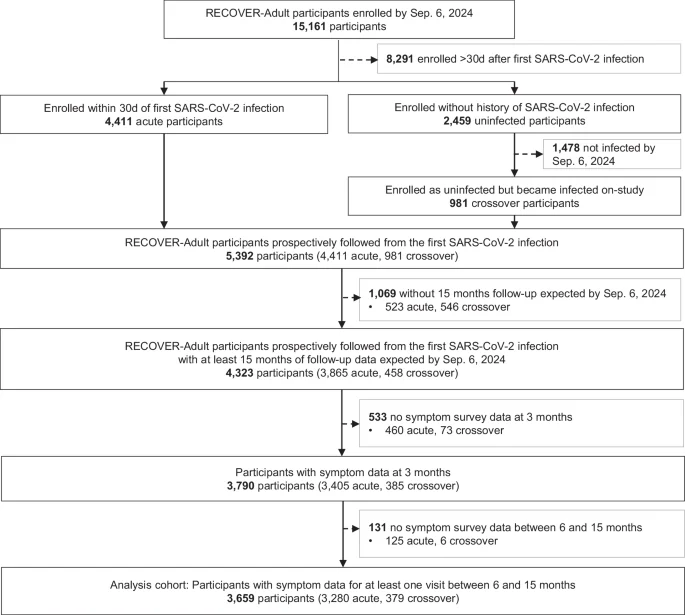
The RECOVER-Adult cohort prospectively followed 4,323 participants from their first SARS-CoV-2 infection. Of these, 3,659 met the inclusion criteria, predominantly comprising females (69%) infected in the Omicron era, with minimal hospitalization rates (98%). A Long COVID Research Index (LCRI) was used to assess symptom burden over a 15-month period.
Finite mixture modeling identified eight distinct longitudinal profiles:
- A: Persistent High Symptom Burden – 195 participants (5%) met the threshold across all visits, often with very high LCRI at three months.
- B: Intermittently High Symptom Burden – 443 participants (12%) fluctuated around a moderate LCRI level.
- C: Improving Moderate Symptom Burden – 379 participants (10%) showed decreasing LCRI over time.
- D: Improving Low Symptom Burden – 334 participants (9%) had lower initial LCRI and decreased to near-zero by six months.
- E: Worsening Moderate Symptom Burden – 309 participants (8%) experienced gradual increases in LCRI over time.
- F: Delayed Worsening Symptom Burden – 217 participants (6%) had low LCRI between months three and twelve but increased post-exertional malaise at month fifteen.
- G: Consistent Low Symptom Burden – 481 participants (13%) maintained generally low LCRI with some intermittent increases not reaching the Long COVID threshold.
- H: Consistent Minimal to No Symptom Burden – 1,301 participants (36%) never met the Long COVID criteria.
Implications for Research and Patient Care
The findings from this study highlight the heterogeneity of Long COVID trajectories. Among participants who met LCRI criteria at three months, 46% were in persistent Long COVID, 35% continued to experience intermittent symptoms, and 19% showed improvement over time. These insights suggest that targeted enrollment strategies for future studies are crucial for understanding pathophysiologic mechanisms, preventive strategies, clinical trials, and treatments.
Furthermore, the study underscores the importance of longitudinal assessments in defining Long COVID trajectories, as reinfection rates were comparable across profiles, indicating potential factors other than new infections may drive symptom progression. This research provides a robust framework for future investigations into Long COVID and supports the development of more personalized approaches to patient care.
For further details on the RECOVER-Adult cohort, visit https://recovercovid.org/.