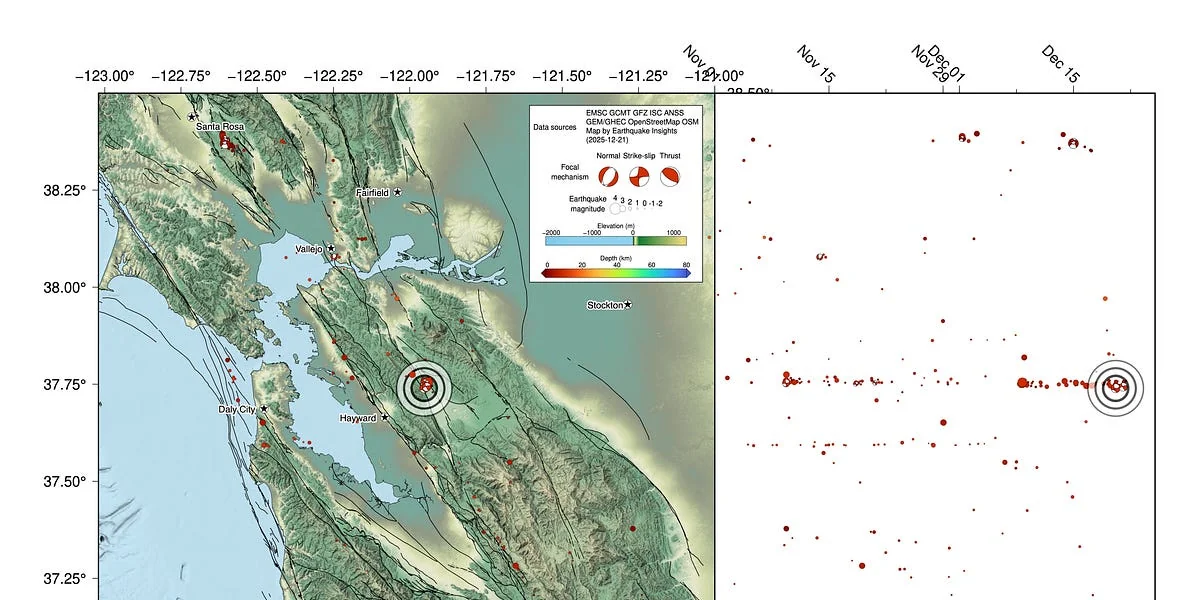
- San Ramon, California is experiencing a swarm of earthquakes over the last month.
- The latest earthquake was a magnitude 4.0 on December 20th (2025-12-20 UTC time).
- Geophysicists confirm that large earthquakes are inevitable in this region due to its fault structures.
- A review of historical seismic activity shows frequent swarms in the San Ramon area, dating back to 1970.
The Current Seismic Swarm in San Ramon, California
Residents of San Ramon, California have been experiencing a series of earthquakes over the past month. The swarm began on November 9th with a magnitude 3.8 event at 9:38 AM local time, followed by a significant magnitude 4.0 earthquake on December 19th (2025-12-20 UTC). These seismic activities have raised concerns among the community and prompted numerous news reports.
Geological Context
The tectonic setting of California provides insight into the frequency of such events. While the San Andreas Fault is a prominent feature, most earthquakes in the region occur on other active fault systems. The current swarm is located below the San Ramon Valley, approximately 45 kilometers northeast of the San Andreas Fault.
The San Ramon Valley is flanked by two major fault systems: the Calaveras Fault System to the southwest and the Pleasanton Fault to the northeast.
Recent seismic activity suggests that the Pleasanton Fault may be responsible for this current episode. However, the precise fault geometry remains under investigation as more accurate relocation of these events could provide a clearer view.
Historical Seismicity in San Ramon
A review of historical seismic data reveals frequent earthquake swarms in the area, dating back to 1970. These clusters have shown various patterns and characteristics, indicating that the current swarm is not unprecedented. Here are some notable historical swarms:
- 1970 Swarm: This began with a small event followed by several smaller ones before intensifying over three months.
- 1978 Swarm: Occurred in August 1976, with events concentrated over two weeks.
- 1990 Swarm: Initiated on a NE-SW oriented plane, cutting across mapped fault traces.
It saw bursts of activity separated by periods of quiescence.
- 2003 Swarm: Started near the Pleasanton Fault and experienced two bursts: one in early 2003 followed by another several months later.
- 2015 Swarm: A particularly interesting sequence, with events migrating both northward and southward over a month.
- 2018 Swarm: Occurred from February to June, with bursts of activity separated by periods of quiescence.
The 2025 swarm shares characteristics with the 2003 sequence, with earthquakes expanding southward and westward over a two-month period. This suggests that similar patterns may be unfolding again in the region.
Expert Insights on Seismicity Mechanisms
The mechanisms behind earthquake swarms can be complex. While typical mainshock-aftershock sequences follow predictable patterns, swarms are characterized by multiple earthquakes within a small area without clear triggering events. This makes their prediction and understanding challenging.
Researchers have explored the dynamics of previous swarms in this region.
For instance, Xue et al.’s (2018) study examined the 2015 swarm and found that it illuminated three different faults dipping towards the northwest, rather than aligning with mapped fault traces. This indicates a more complex geological structure underlying the seismicity.
The current earthquake activity in San Ramon is disconcerting due to its duration and proximity to populated areas. While no major damage has occurred yet, the potential for significant events remains. Local authorities are closely monitoring the situation and advising residents on precautionary measures.