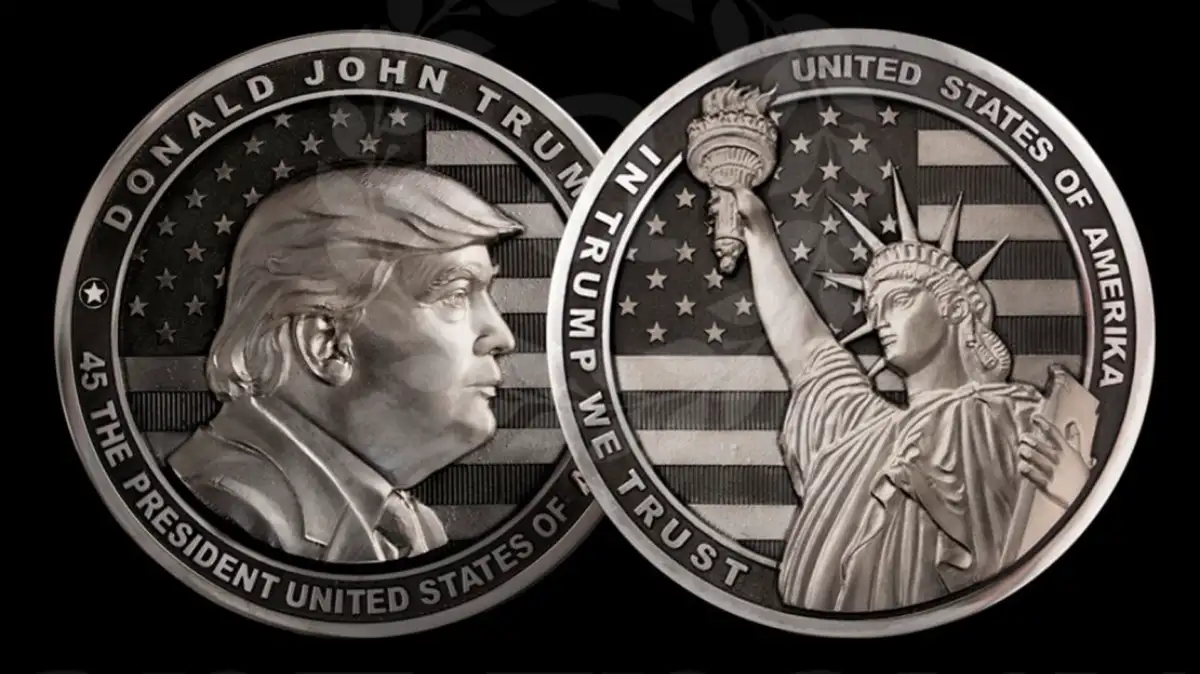
$1 Trump Coin Draft Is ‘Real,’ U.S. Treasurer Confirms (2025): What It Means for Collectors & Investors
TL;DR (for Discover readers)
- The U.S. Treasurer has confirmed that a draft design for a $1 coin featuring President Donald Trump is authentic—but not final and not yet approved for minting.
- The draft is tied to the 250th anniversary of U.S. independence in 2026, part of the broader semiquincentennial coin plans.
- Legal questions remain because U.S. currency traditionally avoids featuring living persons, and some statutes and practices restrict such portraits. Formal review and potential legislative clarifications may follow.
- For collectors and investors, a confirmed mintage could mean high demand, limited supply, and early secondary-market premiums—but only if it’s approved and design details remain close to the draft.
Why This Story Matters Now
A $1 Trump coin—even in draft—touches multiple high-CPM finance angles: policy risk, monetary symbolism, numismatic demand, and collectibles as alternative assets. With the 2026 semiquincentennial approaching, the U.S. Mint and Treasury are under pressure to deliver designs that resonate with the public and collectors.
The confirmation that the “Trump coin draft is real” makes this more than social-media chatter, and pushes the discussion into law, logistics, and market pricing.
What Exactly Was Confirmed
- Authenticity of the draft: The U.S. Treasurer acknowledged that images circulating online are genuine drafts under consideration. That means the concept exists inside government channels, not just as a fan mockup. Important: Draft ≠ approval. Final designs can change—sometimes substantially—before minting.
- Occasion & timing: The draft is linked to the 250th anniversary (1776–2026) commemorations, which historically prompt special coin programs and sometimes high collector interest.
- Proposed visuals (subject to change): Reports describe Trump’s profile on one side, and on the other, a raised-fist motif referencing his widely covered post-assassination-attempt gesture, paired with “fight, fight, fight.” These details are not final but have fueled legal and political debate.
The Law: Can a Living President Be on a U.S. Coin?
This is the core friction point. The U.S. has a longstanding tradition—reinforced in various statutes and Mint policies—not to depict living people on currency. While some language is coin-series-specific (e.g., quarters) and nuanced, the spirit and practice have been consistent: no living portraits on circulating coin designs. Expect lawyers to parse the letter vs. the spirit of the law if this draft moves ahead.
Key takeaways:
- Tradition + policy: “Dead presidents” is more than a phrase; it’s a norm that became law in various forms over time to avoid a cult-of-personality vibe.
- Statutory wrinkles: Certain sections of 31 U.S.C. § 5112 and related provisions govern designs and commemoratives. Lawyers will debate whether specific subsections apply to a semicentenary/sem i quincentennial $1 coin and whether design workarounds (e.g., symbolic scenes vs. a formal “portrait”) change the analysis.
- Bottom line: Any move to mint a coin clearly depicting a living president could face legal challenges, administrative resistance, or require explicit congressional blessing.
If Approved, What Could the $1 Trump Coin Look Like? (Speculative, based on drafts)
- Obverse (front): A profile with inscriptions such as LIBERTY, IN GOD WE TRUST, and 1776–2026 (commemorative timespan).
- Reverse (back): A raised-fist figure before the U.S. flag, plus mottoes like E PLURIBUS UNUM and wording tied to the anniversary and “fight, fight, fight.”
- Edge & specs: If it follows modern dollar-coin standards, expect manganese-brass clad specs similar to past $1 coins—but final metallurgy, mint marks, and finishes (circulation, uncirculated, proof, reverse proof) would be at the Mint’s discretion. (Final specs TBD at approval stage.)
Important: The U.S. Mint typically releases multiple finishes for commemoratives, and limited mintages (or limited order windows) can amplify scarcity and premiums—but only after official approval.
Investor & Collector Angle: Where Could Value Come From?
Even before a coin exists, numismatic markets start gaming out scenarios:
1) Scarcity & Mintage
- Low or capped mintage tends to boost premiums when demand outstrips supply (think early drops selling out in minutes). The Mint could adjust household order limits and product mixes (e.g., 2-coin sets, special finishes).
2) Design Controversy
- Controversial designs often draw attention—and attention can drive viral demand among collectors and non-collectors alike. The “first ever living president on a U.S. coin” narrative (if it survives legal scrutiny) could be historic, either way.
3) Condition & Grading
- Third-party grading (MS/PR-70, First Day of Issue, First Strike) can add significant premiums. Savvy buyers time orders to meet early release criteria and maintain flawless storage. (Standard best practices apply.)
4) Broader Macro Themes
- Inflation worries, currency debates, and political risk often funnel retail interest into tangible collectibles—from bullion to limited coins—especially those tied to headline events. While a base-metal $1 coin isn’t bullion, the collectible narrative can still command strong aftermarket pricing if hype and scarcity align. (Risk remains high and outcomes vary.)
Pro tip: If you’re chasing potential upside, focus on scarcity (low mintage), condition (70 grades), and timing (early releases)—but only with money you can afford to have tied up in collectibles.
Politics, Policy, and Process: What Could Happen Next
- Internal Review: Treasury and the U.S. Mint weigh design compliance, public feedback, and production feasibility.
- Legal Vetting: Expect statutory review on the living-person question, potentially involving DOJ counsel or congressional input if ambiguity persists.
- Design Revisions: Even “real” drafts can be redrawn to sidestep legal minefields—e.g., moving from a formal portrait to a symbolic scene less likely to constitute a “portrait.”
- Public Rollout: If approved, watch for a Mint product schedule, household limits, launch dates, and pricing tiers (circulating-quality rolls, uncirculated coins, proof sets).
How to Prepare (If You’re Interested)
- Follow official channels: Keep an eye on Treasury and U.S. Mint updates for final designs, mintage, and sale windows. (Third-party reports can be noisy; trust the official product page once live.)
- Create an account early: If you plan to buy at release, set up your U.S. Mint account in advance. Popular drops can sell out fast.
- Decide your play:
- Collector play: Buy 1–2 for your set; consider proof or reverse proof if offered.
- Flipper play: Target limited variants and early grading—but remember, hype can fade.
- Long-term hold: Focus on historic significance + top grade + original packaging.
Potential Risks & Misconceptions
- Draft ≠ final: The confirmed draft is real, but approval could stall, change, or be blocked. Don’t pre-price a market that may never materialize.
- Legal tripwires: Even if minted, the living-portrait question may trigger lawsuits or require last-minute modifications.
- Counterfeit risk: Viral designs inspire scams. Only buy from the U.S. Mint or reputable dealers with clear return policies and grading guarantees.
SEO-Friendly Glossary (Beginner-Ready)
- Commemorative Coin: A coin marking a special event, sold mainly to collectors; sometimes legal tender but not meant for daily spending.
- Mintage: How many units are produced; lower mintage often means higher scarcity.
- Proof/Reverse Proof: Premium finishes produced with special dies and planchets, popular with collectors.
- Grading (MS/PR-70): Independent quality score; 70 is essentially perfect.
- Semiquincentennial: The 250-year anniversary of the United States (1776–2026).
- Numismatics: The study and collecting of coins and currency.
Frequently Asked Questions (FAQs)
Q1: Is the $1 Trump coin officially approved?
A: Not yet. The U.S. Treasurer confirmed the draft is real, but final approval, production, and sale dates have not been announced.
Q2: When could it launch if approved?
A: The concept aligns with the 2026 anniversary, so any launch would likely target the 2025–2026 window, depending on legal clearance and the Mint’s production schedule.
Q3: Is it legal to put a living person on a U.S. coin?
A: U.S. practice and various statutes discourage or restrict such depictions. Expect intense legal review and possible design tweaks or legislative action if the project moves forward.
Q4: Will it be worth more than face value?
A: If minted with limited mintage and high demand, it could trade above issue price, especially in top grades or special finishes. But collectibles are volatile and not guaranteed investments.
Q5: How can I avoid fakes?
A: Buy directly from the U.S. Mint at release or through established dealers. Seek certified coins (from major grading services) for big-ticket purchases.
Q6: Could the design change?
A: Absolutely. Many commemoratives evolve from early drafts to final art. The phrase, pose, or even whether a portrait appears at all could change amid legal review.
Action Plan for Readers (Simple, Professional, Beginner-Friendly)
- Monitor: Track official Treasury/U.S. Mint updates for final decision and sale dates.
- Budget: Decide how much you’re willing to allocate to collectibles (distinct from your core investing in diversified assets).
- Prioritize Finishes: If options appear, proof and reverse proof often hold stronger collector appeal.
- Consider Grading: If you’re chasing long-term value, graded MS/PR-70 with early release labels can matter.
- Stay Skeptical: Until official product pages and SKUs are live, ignore unofficial preorders or too-good-to-be-true offers.
Conclusion: A Real Draft, Many Unknowns — and Big Collector Curiosity
The U.S. Treasurer’s confirmation that the $1 Trump coin draft is real pushed the idea from rumor into policy conversation. But that’s only step one.
The decisive questions—Is it legal? Will the design change? Will it actually be minted?—remain open. If it does reach production with a living-portrait-style design, it’s poised to become one of the most talked-about U.S. coins in decades, with collector demand, secondary-market premiums, and political debate all colliding.
For now, the smartest move is to watch official updates, plan your budget, and prepare for fast sellouts—if the Mint greenlights what could be a historic (and highly controversial) release.