Key Highlights
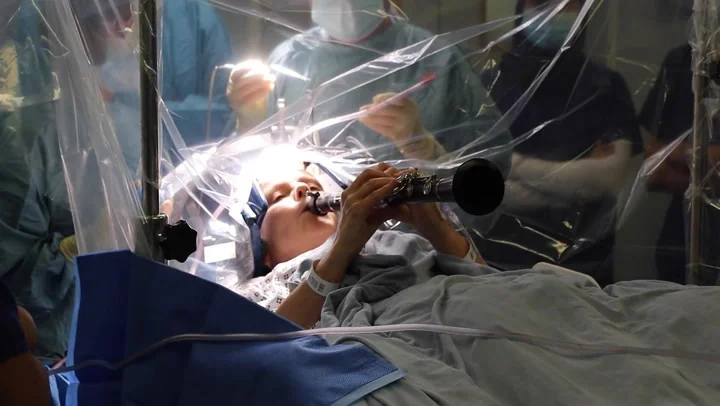
- A 65-year-old woman with Parkinson’s disease played the clarinet during a four-hour brain surgery to help fine-tune her deep brain stimulation (DBS) procedure.
- The professor of neurosurgery, Keyoumars Ashkan, performed the DBS operation at London’s King’s College Hospital while the patient remained awake.
- Denise Bacon’s continuous clarinet playing helped to adjust the electrodes inside her brain until she was able to play her instrument as intended.
- This innovative approach demonstrates the potential of combining music with medical procedures to enhance patient outcomes in neurological surgeries.
Musical Surgery: A Unique Approach to Parkinson’s Treatment
Denise Bacon, a 65-year-old woman living with Parkinson’s disease, recently underwent an extraordinary procedure at London’s King’s College Hospital. The unique aspect of this operation wasn’t just the deep brain stimulation (DBS) intended to reduce her symptoms—it involved playing the clarinet during the four-hour surgery.
Keyoumars Ashkan, a professor of neurosurgery, performed the DBS operation while Bacon remained awake and played her beloved instrument. According to Ashkan, this approach allowed them to “fine-tune the position of the electrodes deep inside her brain” by observing how her fingers moved during the clarinet performance.
Overcoming Parkinson’s Symptoms through Music
Bacon has faced significant challenges due to Parkinson’s disease, including difficulties in walking, swimming, dancing, and playing her clarinet. The decision to play the instrument during surgery was not only a personal choice but also a strategic one aimed at improving surgical precision.
“It was just amazing,” Bacon shared with BBC, describing the experience of seeing and feeling her fingers move “better and faster” during the operation. This anecdotal evidence suggests that integrating music into medical procedures can provide valuable insights into a patient’s neurological state, enhancing the accuracy of surgeries like DBS.
Neurological Innovations in Patient Engagement
The use of patient engagement techniques such as music during brain surgery is part of a broader trend towards more interactive and personalized approaches to medical procedures. By allowing Bacon to continue playing her instrument, Ashkan was able to optimize the placement of electrodes within her brain, potentially leading to better long-term outcomes.
Dr. Daniel Hanley, an associate professor at Johns Hopkins University School of Medicine who specializes in neurology, explains that such innovative methods can help improve surgical outcomes by providing real-time feedback on a patient’s neurological function. “This kind of approach is exciting because it personalizes the treatment for each individual,” he notes.
Experts like Hanley highlight how combining music with surgery can be particularly beneficial for patients with Parkinson’s disease, who may experience fluctuations in their condition that traditional imaging techniques might not capture as accurately. The continuous movement and coordination required to play an instrument can offer a dynamic view of the brain’s response to surgical adjustments.
Future Implications for Neurosurgical Procedures
The success of Bacon’s surgery points towards potential advancements in neurosurgical practices. As more research explores the integration of art and music into medical procedures, we may see similar innovative approaches become standard practice.
“This case is a wonderful example of how arts can intersect with healthcare,” comments Dr. Hanley. “It shows that there’s a lot of untapped potential for creativity in medical fields.” He envisions a future where such techniques are used more widely, not just to improve surgical outcomes but also to boost patient morale and engagement during procedures.
As the field of neurosurgery continues to evolve, the integration of music into surgeries like DBS could become an increasingly common practice. This innovative approach represents a significant step forward in personalized treatment methods for patients with neurological conditions like Parkinson’s disease.
The story of Denise Bacon and her clarinet-playing during surgery is not only remarkable but also holds promise for future medical advancements, blending the worlds of art and science to enhance patient care.