Key Highlights
- The sequel to “Wicked” faced challenges in translating the complex second act of L. Frank Baum’s “The Wonderful Wizard of Oz.”
- Director Jon M. Chu emphasized that the second film was about going deeper into character development rather than simply becoming darker.
- Chu and his team used detailed planning, including emotion labels for each scene, to ensure consistency in storytelling across two films.
- The finale number “For Good” became a powerful symbol of the transformational journey of the characters Elphaba and Glinda.
From Theatrical Success to Screen Adaptation: The Journey of Wicked
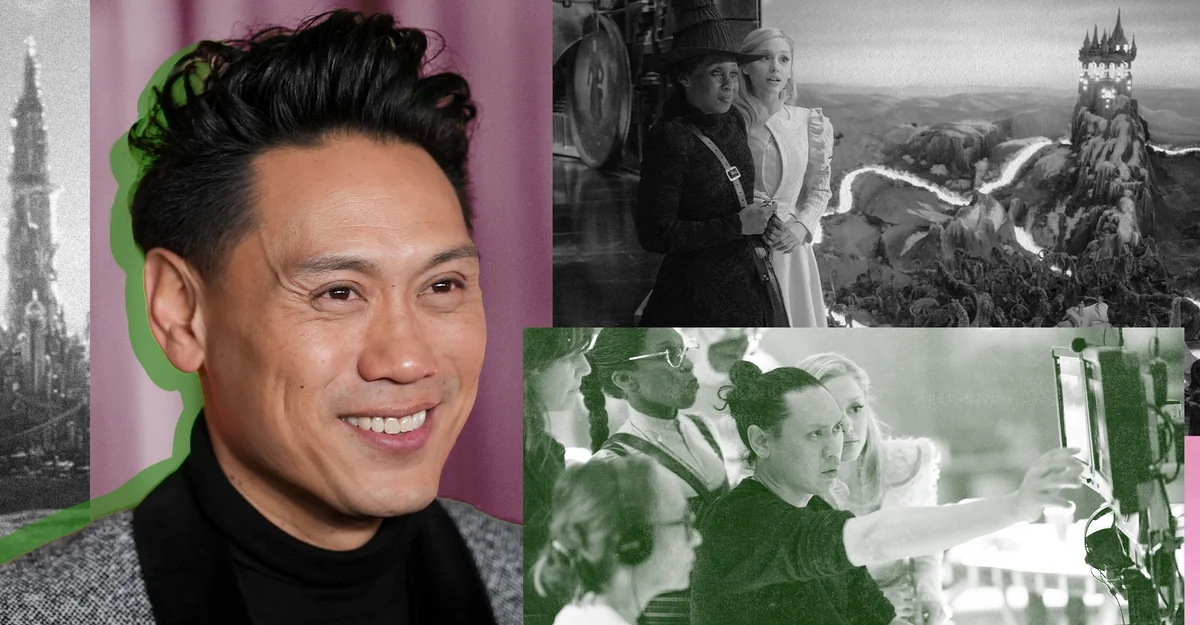
The musical sensation “Wicked,” which originated on Broadway, has captured hearts for over two decades. Its adaptation into a film was no small feat, as director Jon M. Chu had to navigate the complex narrative and emotional depth of its second act. In an exclusive interview with Shirley Li, Chu shares insights into his creative process and the challenges of bringing “Wicked” to the big screen.
Deconstructing Fairy Tales: The Two-Act Strategy
Chu knew early on that splitting “Wicked” into two films was essential. “You usually have a few weeks right when you jump on a project when you’re king, so you better make the big decisions,” Chu told Li. The decision to create two films allowed for a more nuanced exploration of Elphaba and Glinda’s journey from innocent girls to the Wicked Witch of the West and Oz’s It Girl.
“We couldn’t keep going back and forth,” Chu explained, emphasizing that the project needed clarity early on. “There was no in between. But to me, it was like, the movie needs the room.” The director saw these two films as a one-year experience, with the gap serving as critical time for audience absorption of the story before its shattering.
Challenges and Collaborations: A Complex Production
The production of “Wicked” was anything but straightforward. Chu embarked on this project shortly after the underwhelming box office performance of his previous musical, “In the Heights.” The pandemic further complicated matters, making it difficult to gauge audience interest in a full-scale musical film.
“Honestly, it’s weird to say, but I didn’t fear a lot at that moment,” Chu admitted. “We didn’t have much to lose.” However, he was concerned about fan expectations and his relationship with the original writers, Stephen Schwartz and Winnie Holzman. The director felt that if these creators were not on board, the project could fail. Thankfully, they trusted him to take the necessary creative risks.
Planning for Depth: Emotions and Design
To keep track of his vision for two films, Chu employed a detailed planning system. “I saw it as one giant story,” he said. Each scene was labeled with the emotion Chu wanted the audience to feel. This approach extended beyond just the scenes themselves; every department had their own version of these maps.
For instance, Cynthia Erivo used perfumes to mark scenes, while Ariana Grande’s notes were “like a madman’s notes.”
The crew also maintained a war room filled with models, pictures, fabrics, and designs for everything from color schemes to character movements. This meticulous planning ensured that each film was its own coherent story, yet part of the larger narrative arc.
Transforming Characters: From Bubbly Musicals to Deep Stories
The first film, according to Chu, served as a Trojan horse—a way to deliver big musical elements before delving into deeper themes. “The biggest advantage we ever got from the 20-year production of Wicked onstage was the mantra that the producers handed to me,” Chu recalled. “‘It’s about the girls, stupid.’”
This focus on character development became central to “Wicked: For Good.” The finale number, “For Good,” became a powerful symbol of the characters’ transformational journey. “The thing that trapped me for ‘For Good’ early was the fact that it’s the last song of the two-movie saga,” Chu said. “I don’t want to leave their faces when they’re singing these words.” The restrained performance became a poignant moment, emphasizing the emotional depth of the characters’ relationships.
Chu’s approach paid off as audiences and critics alike recognized the complexity and depth of the sequel. “It’s not about getting to a destination,” Chu concluded. “Just keep walking, and you’ll end up at the place you need to be.”