Key Highlights
- Rian Johnson’s “Wake Up Dead Man” is a murder mystery that intertwines with themes of faith and politics.
- The film draws heavily from the works of classic detective fiction author John Dickson Carr, specifically his “Locked-Room Lecture.”
- Josh O’Connor plays Father Jud Duplenticy, a young priest sent to serve in a church under threat from its intolerant leader.
- Rian Johnson’s direction balances humor and theological debate, creating a complex narrative that challenges traditional detective story tropes.
The Genesis of a Modern Whodunnit: Rian Johnson’s “Wake Up Dead Man”
Director Rian Johnson continues to weave his unique brand of humor and social commentary into the fabric of his latest film, “Wake Up Dead Man.” This intriguing mystery takes its inspiration from the golden age of detective fiction, particularly the works of John Dickson Carr. The movie’s title is a nod to Carr’s influence on the genre, as well as the central theme of resurrection and redemption that runs through the narrative.
A Homage to Classic Detective Fiction
Johnson has always been an admirer of the detective fiction genre. In his introduction for “The Problem of the Wire Cage,” a re-release of one of Carr’s novels, he expressed how deeply the author’s works had impacted him. The current film serves as a celebration of this literary tradition while infusing it with contemporary themes and social critiques.
The Characters: A Melange of Modern Paradoxes
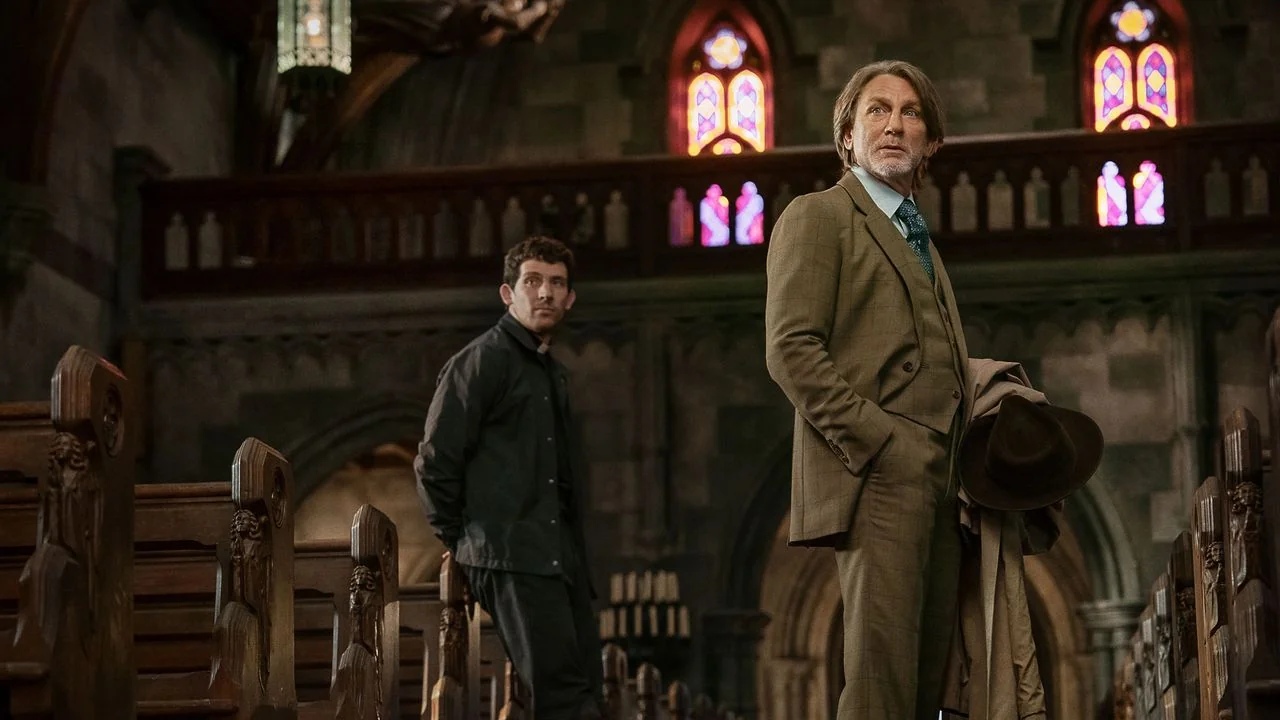
At the heart of “Wake Up Dead Man” is Father Jud Duplenticy, played by Josh O’Connor. This young priest arrives at Our Lady of Perpetual Fortitude with a fresh perspective and a willingness to embrace his parishioners in their human brokenness. His presence immediately draws the ire of Monsignor Jefferson Wicks (Josh Brolin), who sees him as a threat to his authoritarian rule over the church.
Wicks, a complex character himself, is not just a villain but a deeply flawed and contradictory figure.
His intolerance and hatred towards certain groups are countered by his own deep-seated issues, including his abusive past. The film explores the dynamics between these characters through a series of tense confrontations and psychological warfare, culminating in a tragic murder that sets the plot into motion.
The Plot: Impossible Crimes and Faithful Detectives
When Monsignor Wicks is fatally stabbed during his Good Friday homily, the film’s protagonist, Benoit Blanc (Daniel Craig), arrives to solve the mystery. Blanc’s investigation takes a turn when he delivers an impromptu lecture on impossible crimes, reminiscent of Carr’s “Locked-Room Lecture.” This moment serves not only as a homage but also as a reflection on the nature of faith and its role in solving seemingly unsolvable puzzles.
The film’s narrative is peppered with religious symbolism and theological debates. Johnson uses these elements to critique modern interpretations of Christianity, particularly within the context of American politics. The characters’ struggles reflect broader societal issues, making “Wake Up Dead Man” a multi-layered exploration of faith, power, and morality.
A Critique of Modern Faith Movements
Johnson’s film is a sharp critique of the unholy alliance between Christianity and the political right. It delves into themes of intolerance, insularity, and misogyny that have taken root in certain religious communities. The movie also examines how easily disgruntled clergymen can become radicalized figures on social media platforms, highlighting the dangers of unchecked power and rhetoric.
Despite its heavy-handed themes, “Wake Up Dead Man” manages to maintain a balance between humor and serious content. Josh O’Connor’s portrayal of Father Jud is both moving and nuanced, capturing the complexity of a character caught between his faith and the challenges he faces in his new role.
A Masterclass in Modern Whodunnits
Rian Johnson’s direction in “Wake Up Dead Man” demonstrates his mastery over the genre. The film is not just a murder mystery but a meditation on the human condition, blending elements of faith with social commentary. By drawing from classic detective fiction while addressing contemporary issues, Johnson creates a narrative that resonates with both longtime fans and new audiences.
In conclusion, “Wake Up Dead Man” stands as a testament to Rian Johnson’s vision and his commitment to exploring the intersection of entertainment and social critique. It is a film that challenges viewers to question their own beliefs and values while providing a thrilling ride through a world where impossible crimes are not just fiction but a reflection of reality.