Key Highlights
- The Turkish KAAN fighter aircraft faces significant challenges due to its reliance on U.S.-built General Electric F110 engines under CAATSA sanctions.
- Without a U.S. export license, the production and maintenance of KAAN are at risk, affecting foreign buyers like Indonesia.
- Turkey is developing domestic engine alternatives but faces long timelines and technical challenges in achieving self-sufficiency.
The KAAN Trap: Turkey’s Multibillion-Dollar Fighter Aircraft Faces External Dependencies
By ET Columnist – November 24, 2025 ShareFacebookTwitterWhatsAppReddIt OPED By Shay Gal
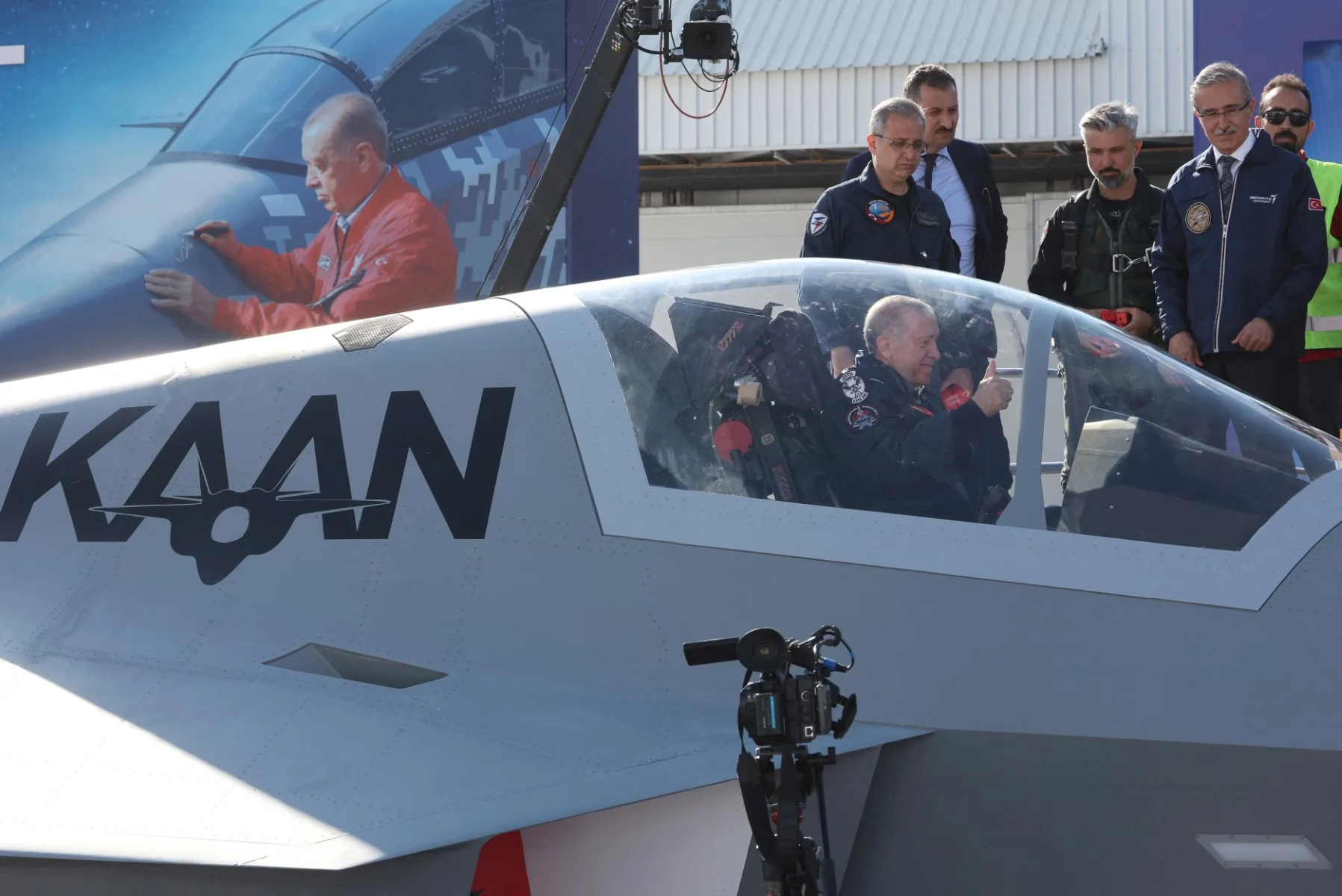
The Turkish KAAN fighter aircraft has been marketed as a significant milestone in Ankara’s defense industry. However, behind the marketing lies a complex web of external dependencies that threaten its success and sustainability.
KAAN: A Technological Ambition with Rhetorical Overtones
The KAAN first took flight in February 2024, marking a genuine industrial achievement for Turkish Aerospace Industries (TAI). The program aims to deliver around 20 “Block 10” aircraft to the Turkish Air Force by 2028-2029 with serial production envisioned for the 2030s. On paper, KAAN aspires to join the ranks of fifth-generation fighter jets like the F-35, but this ambition is more rhetorical than technological.
Export Licenses and Political Constraints
The core weakness of KAAN lies in its propulsion system: every prototype and early production aircraft relies on U.S.-built General Electric F110 engines. Under the Countering American Threats Act (CAATSA) sanctions, these engines require an export license from the United States. Without it, the production, delivery, and maintenance of KAAN are at the mercy of external decisions.
According to Turkey’s own Foreign Minister Hakan Fidan, in late September 2025, “the F110 license is stuck in Congress.” This political reality has significant implications for foreign buyers. For instance, Indonesia, which signed a contract for 48 aircraft worth approximately $10 billion, faces the risk that maintenance cycles and upgrade paths will be dictated by U.S. law rather than Indonesian preferences.
Domestic Engine Development: A Long Road Ahead
Turkey is racing to develop a domestic engine solution through TEI (Turkish Aerospace Industries) and TRMotor, targeting the TF-35000 high-thrust turbofan for early 2030s ground tests. However, even optimistic projections suggest that integrating this engine into KAAN will take years of rigorous testing and development. The geopolitical risks are further compounded by Turkey’s tense relations with the United States and Europe, which could result in sudden disruptions to the supply chain.
For countries like Indonesia, already juggling multiple fighter platforms such as Rafale, KF-21, and F-15ID, KAAN introduces an additional dependency on U.S. law and politics. Similarly, other buyers with complex geopolitical sensitivities—such as Pakistan, Azerbaijan, Egypt, and Gulf states—are at risk of being bound by the same foreign choke point.
Strategic Hedges and Future Uncertainties
Turkey’s own fleet plans reveal its cautious approach. Ankara is acquiring Eurofighter Typhoons, negotiating for Qatari and Omani Typhoons, and still attempting to rejoin the F-35 program. These hedges reflect the understanding that KAAN alone cannot shoulder Turkey’s air-power burden in the near future.
The parallel with Israel’s Lavi program is instructive: despite being a groundbreaking design, the Lavi faced cancellation due to external pressures and domestic politics.
The same risk applies to KAAN, which carries an unintended warning that its success hinges on permission rather than power.
Turkey will not cancel KAAN regardless of cost or difficulty; politically, symbolically, and industrially, it cannot afford to do so. But foreign governments still have significant agency. They can either invest billions in a fighter whose future remains uncertain due to export licenses and political weather, or wait until it is powered by an engine answerable only to Ankara.
Until then, KAAN remains what its title suggests: a jet built on permission, not power.