and Service Employees International Union Local 99) felt compelled to threaten another walkout, this time along with the administrators’ union.
A Nationwide Backlash
Armaghan Khan, a middle school science teacher and member of the UTLA bargaining team, told Jacobin that the district’s spending on tech contracts was a primary focus of the threatened strike. Khan says LAUSD is at an inflection point — part of the nationwide bipartisan backlash against Silicon Valley’s takeover of public schools.
In April, the LAUSD school board unanimously voted to place guardrails around student-facing technology, including an audit of outside contracts. The district’s new guidelines will be finalized on June 23 and have already inspired similar proposals in New York, Washington, DC, and elsewhere.
Reevaluating School
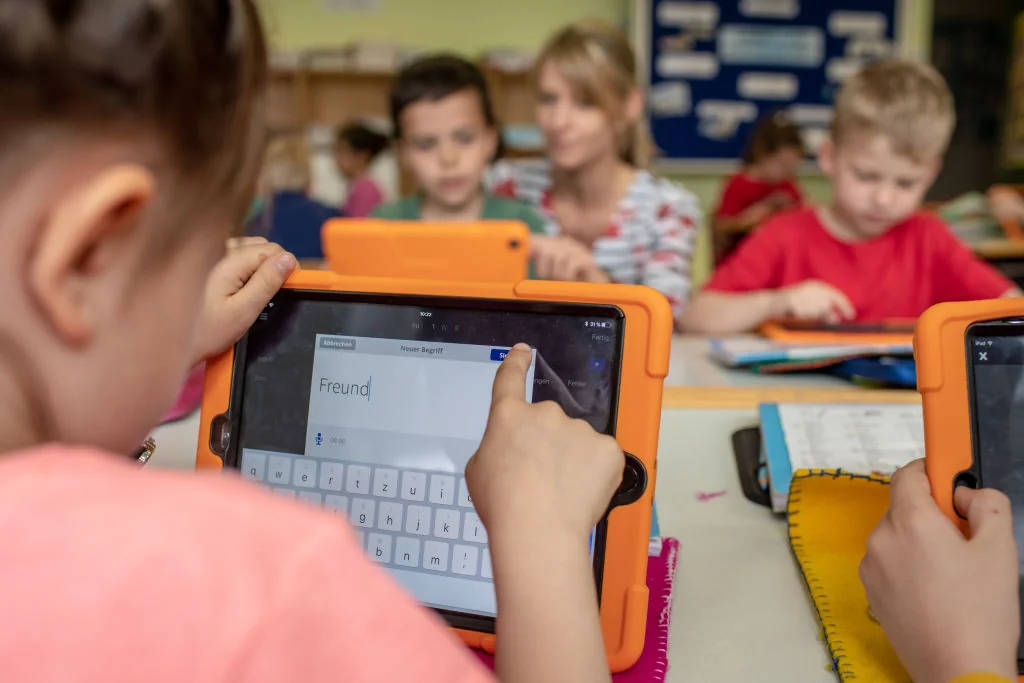
Schools Beyond Screens members Kate Brody and Sandra Martinez Roe say they’re just getting started. As parents, educators, and lawmakers across the United States make the case that school shouldn’t be a place where kids zone out on devices, interact with risky algorithms, or unwittingly hand over data to profit-driven third parties, we have the opportunity to ask ourselves: How should we think about school?
Technology’s allure is always future oriented: Personal computing was going to supercharge productivity; social media and smartphones would strengthen interpersonal connections; and now AI will streamline the world of work. But as Charles Logan, T.
Philip Nichols, and Antero Garcia recently argued in Kappan, “the future they’re selling has not arrived — and perhaps it never will. But de-skilling, surveillance, and extraction — all of that is happening now, in our classrooms, today.”
“It just doesn’t make sense to train six-year-olds on technology that may be obsolete in a few years,” Kate Brody told Jacobin. Nor does it make sense to train them “on consumer-facing technologies that are designed to be used intuitively” — as opposed to, say, reading, which is anything but intuitive.
Brody says we’ve been “making bizarre tradeoffs in K–12, and a lot of that is driven by fear.” Armaghan Khan agrees that fear about test scores has caused school leaders to buy into overhyped edtech. “I don’t find planning lessons, grading materials, or meeting with parents or students to be drudgery at all,” he told Jacobin. “Those are the elements of my profession that keep me coming back.”
If we offload this vital human labor, what’s left? “When this whole thing started, I was like, who’s making money off of it?” Sandra Martinez Roe recalls. “I feel like these technology companies have their claws out for our little ones.”