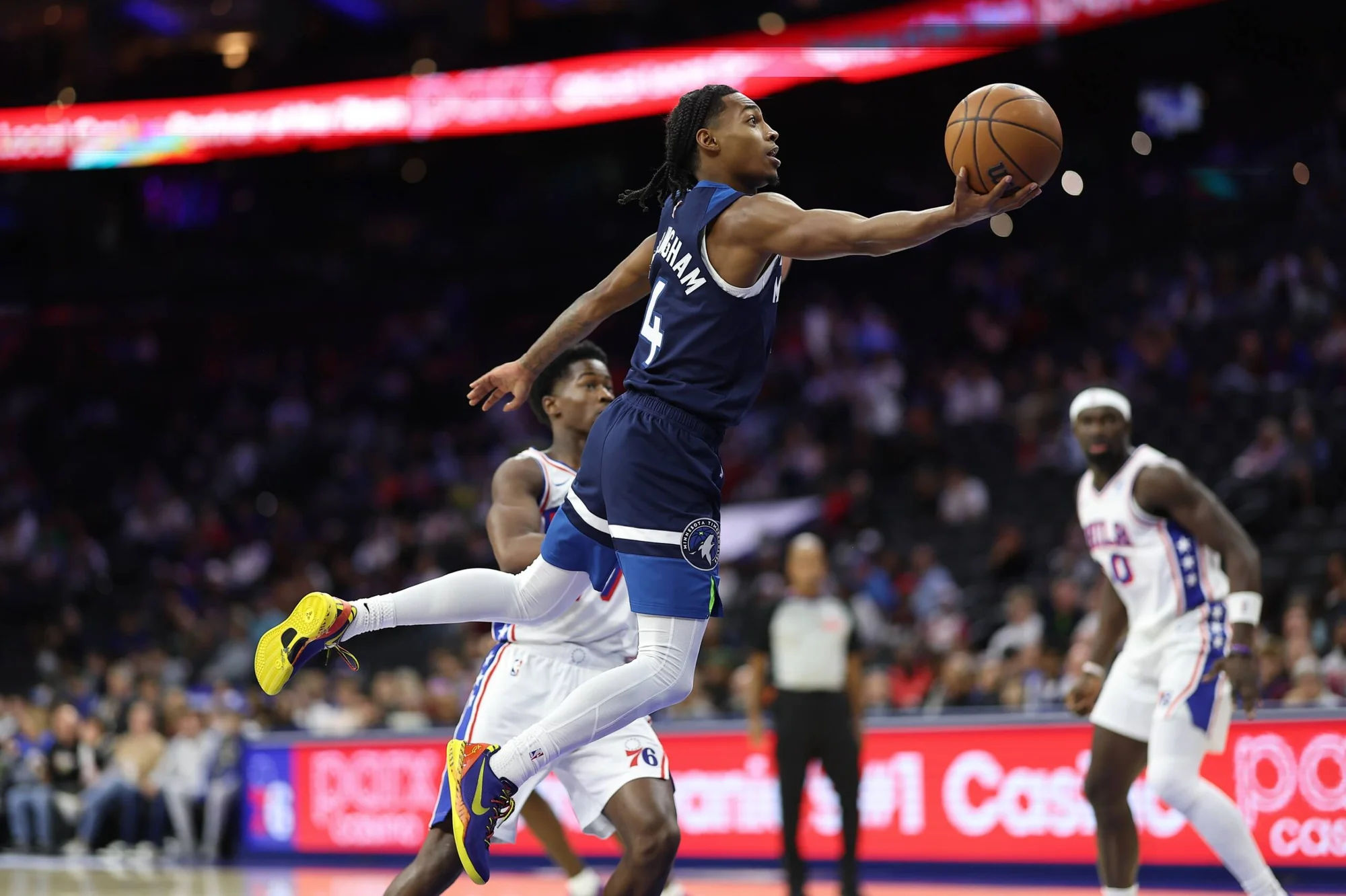
Key Highlights
- Rob Dillingham is showing promise in the preseason with the Minnesota Timberwolves.
- The player’s game still exhibits a mix of strengths and weaknesses.
- Dillingham’s shooting has improved, but turnovers remain a concern.
- Defensively, his intensity and willingness to fight have been praised by teammates.
The Promise and Challenges of Rob Dillingham’s Development
Minnesota Timberwolves guard Rob Dillingham is making the most of his second preseason with the team, showcasing both positive developments and lingering issues. As he seeks to earn rotation minutes after being largely benched in his rookie season, Dillingham’s performance reflects a mix of promise and ongoing challenges.
Shooting Improvements and Turnover Struggles
Dillingham has shown significant improvement in his shooting accuracy this preseason. He averaged 10.7 shots per game with a respectable 45.3% field goal percentage, including notable success from beyond the arc where he hit 8 of 17 three-point attempts over six games. This growth is attributed to consistent practice and guidance under developmental coach Pablo Prigioni.
However, his shooting mechanics still need refinement, as Dillingham tends to jump towards the basket rather than executing a clean vertical release.
While his shooting has improved, turnovers remain a critical area for improvement. Dillingham demonstrated flashes of control with three games where he had only one turnover each, but these were interspersed with another game where he committed 12 turnovers and dished out just two assists. This inconsistency could impact his playing time during the regular season if such performances are replicated.
Defensive Efforts and Team Contributions
The Wolves have praised Dillingham for his defensive effort, despite his smaller stature. His intensity and willingness to fight are evident in his play, as highlighted by teammate Naz Reid. “He has heart,” said Reid, emphasizing Dillingham’s relentless spirit on the court. While Dillingham may never be a lockdown defender due to his size, his efforts around screens, off-ball defense, and rebounding contribute significantly to team success.
Despite these contributions, Dillingham faces the challenge of managing turnovers effectively without losing playing time. His ability to harass ball handlers and fight for rebounds can make him an asset on defense, but these defensive plays often don’t translate into box score statistics.
The Road Ahead: Overcoming Adversity
As Dillingham looks to secure a role in the Timberwolves’ rotation, his journey reflects both the highs and lows typical of young players navigating their careers. His coachability and dedication during the offseason have yielded tangible improvements on the court. However, overcoming turnovers will be crucial for him to maintain consistent playing time.
“Adversity comes with everything,” Dillingham said before a preseason game against the Pacers. “So if you keep trying at it, you’re going to overcome it.” This mindset aligns with the broader narrative of player development in professional basketball, where perseverance and adaptability are key to success.
For now, Dillingham finds himself back in a similar position as he did during summer league and parts of his rookie season.
The path forward involves continued improvement and consistency, both on and off the court. As the regular season approaches, the Timberwolves will be watching closely to see how Dillingham evolves into a more reliable contributor.