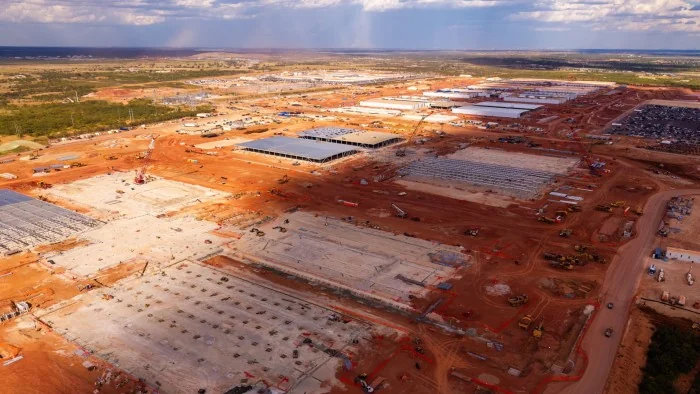
Key Highlights
- Oracle’s stock has shed $315bn in market value since the September 10 announcement of a $300bn deal with OpenAI.
- The deal has led to Oracle becoming an “OpenAI US public market proxy,” as it bets heavily on scaling data center capacity for this AI project.
- Oracle’s net debt is already at 2.5 times EBITDA, and it’s expected to nearly double by 2030 due to the deal.
- The company aims for cloud computing revenue of $166bn by 2030, with OpenAI contributing significantly to this target from 2027 onwards.
Oracle’s Massive Investment in AI: The Cost and Risks
Oracle has announced a “astonishing” $300bn deal with the renowned chatbot maker, OpenAI. However, since this monumental agreement was made on September 10, Oracle’s stock has experienced a significant drop, losing $315bn in market value. This article delves into the implications and financial risks of this ambitious venture.
Market Value Loss and Financial Implications
The stark contrast between the deal’s scale—worth an astounding $300bn—and Oracle’s current stock performance highlights the uncertainty surrounding such a large investment in artificial intelligence. Bryce Elder, an analyst reporting on the matter, notes that while it might be too early to definitively label this as the “Curse of OpenAI,” investor unease is palpable.
According to Elder, the $60bn loss figure is not entirely off-base when compared with industry equivalents. Shares in Oracle’s competitors, such as Microsoft and Dow Jones US Software Index, have remained relatively stable over the same period, suggesting that while the loss appears substantial, it may be a reasonable reflection of market sentiment.
Financial Stakes and Debt Burden
The investment into OpenAI comes with significant financial implications for Oracle. The company’s capital expenditure (capex) budget for the current fiscal year is set at $35bn, aiming to reach $80bn annually by 2029. However, by 2030, a majority of Oracle’s revenue is expected to come from its partnership with OpenAI.
But, this ambitious growth strategy comes with a high price tag.
As of now, Oracle’s net debt stands at 2.5 times EBITDA, more than doubling since 2021. Analysts predict that by 2030, the company’s net debt could nearly double again, posing significant financial risks.
Investor Warnings and Market Uncertainty
The deal has not only affected Oracle’s stock price but also its credit default swap (CDS) premiums, which have reached a three-year high. Credit-default-swap liquidity is not great, and the increased demand for Oracle CDS comes after $18bn in bond sales in September.
Despite these warnings, Elder suggests that some firms taking the other side of the trade are no mugs, implying that there might be strategic buyers or sellers involved. However, he notes that the current situation is “pointy,” indicating a delicate balance between risk and potential reward for Oracle shareholders.
The Future of AI in Business
As technology companies race to define and unlock the potential of artificial general intelligence (AGI), the stakes are higher than ever. Oracle’s bold move into this space is reflective of a broader trend in the tech industry, where large corporations are investing heavily to stay competitive.
However, the Oracle-OpenAI deal also raises questions about investment fashions and their volatility. While some companies have seen positive market reactions to similar deals, others like Nvidia and Broadcom have experienced negative impacts on their stock prices.
In conclusion, while Oracle’s $300bn investment in OpenAI is a bold step towards defining the future of AI, it also comes with significant financial risks that must be carefully managed. As the tech industry continues to navigate the complex landscape of AI and its applications, the outcomes for players like Oracle will shape not only their own futures but also the broader technological and economic landscape.