Key Highlights
- Nvidia partners with over 20 companies to prepare the data center industry for 1MW racks and 800-volt DC power architectures.
- The Vera Rubin NVL144 MGX-generation open architecture rack servers are set to be unveiled by Nvidia.
- Over 150 percent more power is transmitted through the same copper with 800-volt DC, eliminating the need for heavy copper busbars in data centers.
- Nvidia’s Kyber system connects 576 Rubin Ultra GPUs and is designed to support increasing inference demands.
The Evolution of Data Center Power Architecture
Nvidia has taken a significant step towards revolutionizing the data center infrastructure with its plans for 800-volt direct current (VDC) power architectures. This move is part of Nvidia’s broader strategy to enhance rack density and energy efficiency, addressing the increasing demands of artificial intelligence (AI) workloads.
The transition from traditional 415 or 480-volt alternating current (VAC) three-phase systems to 800-volt DC infrastructure offers several advantages. According to Nvidia, moving to 800VDC can increase scalability, improve energy efficiency by over 150 percent more power transmission through the same copper, and reduce the need for heavy and cumbersome copper busbars.
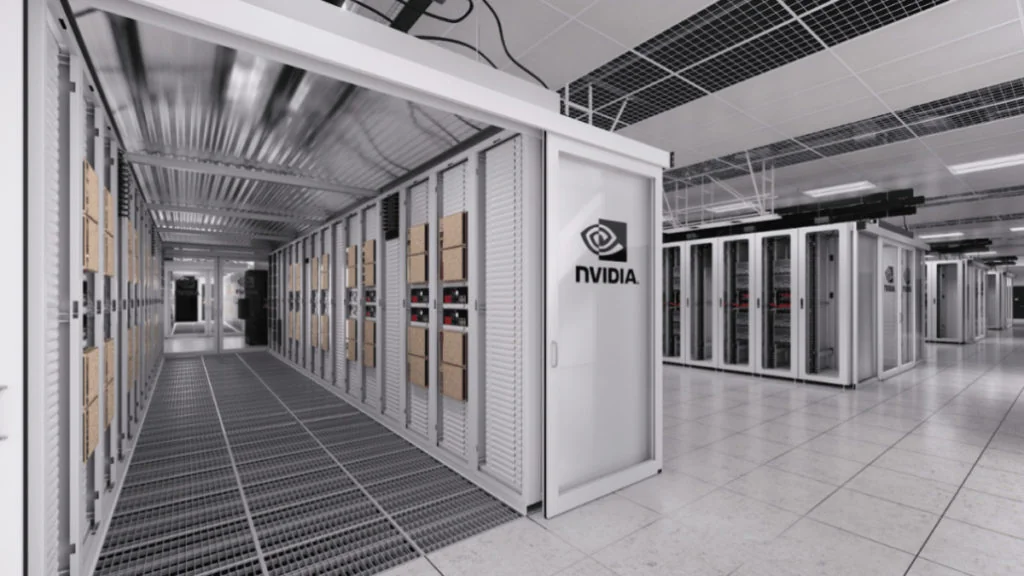
Nvidia’s Vera Rubin NVL144 Rack Design
The new Vera Rubin NVL144 rack design is a cornerstone of Nvidia’s push towards 800-volt DC power systems. This innovative architecture features several key improvements, including 45°C (113°F) liquid cooling, a new liquid-cooled busbar for higher performance, and increased energy storage to maintain steady power.
Notably, the Vera Rubin NVL144 rack design utilizes a central printed circuit board midplane, replacing traditional cable-based connections. This design not only accelerates assembly but also enhances serviceability, making maintenance more efficient.
The Silicon Providers and Ecosystem Support
Nvidia has enlisted support from numerous chip providers to make this transition feasible. Companies such as Analog Devices, AOS, EPC, Infineon, Innoscience, MPS, Navitas, onsemi, Power Integrations, Renesas, Richtek, ROHM, STMicroelectronics, and Texas Instruments are contributing their expertise in advanced power semiconductors, particularly silicon carbide (SiC) and gallium nitride (GaN).
These providers highlight the critical role of these advanced materials in handling higher voltages and frequencies with maximum efficiency. For example, AOS stated that 800VDC requires a shift towards more efficient power chips and power supply units (PSUs), with many emphasizing their capabilities in gallium nitride.
Several data center power system component providers have also joined the initiative, including BizLink, Delta, Flex, GE Vernova, Lead Wealth, LITEON, and Megmeet. These companies are developing new power shelves, liquid-cooled busbars, energy storage systems, and interconnects to meet the demands of Nvidia’s new systems.
Industry Commitment and Future Implications
The move to 800-volt DC infrastructure is gaining traction among major data center operators. Companies like CoreWeave, Lambda, Nebius, Oracle Cloud Infrastructure, and Together AI are designing for this new standard. Even Foxconn’s 40MW Kaohsiung-1 data center in Taiwan has adopted the 800VDC architecture.
Industry experts see this shift as a natural evolution to meet increasing compute density demands.
Jim Simonelli, CTO of Data Centers at Schneider Electric, commented, “The move to 800VDC is a natural evolution as compute density increases. Our expertise lies in understanding the full power ecosystem, from grid to server, and designing solutions that integrate seamlessly, perform predictably, and operate safely.”
As data centers continue to evolve, the adoption of 800-volt DC power architectures represents a significant step forward in energy efficiency and scalability. Nvidia’s collaboration with multiple partners underscores the industry-wide commitment to these advanced technologies.