Key Highlights
- Notre Dame quarterback CJ Carr is projected to be a first-round pick after next season.
- The Irish defense has improved significantly, holding multiple teams under their scoring averages.
- CJ Carr’s development and performance have been critical for Notre Dame’s rise in the rankings.
- Key players like Joe Otting and Sullivan Absher are expected to take on more significant roles as the season progresses.
The Rise of CJ Carr: From Near Miss to First-Round Prospect
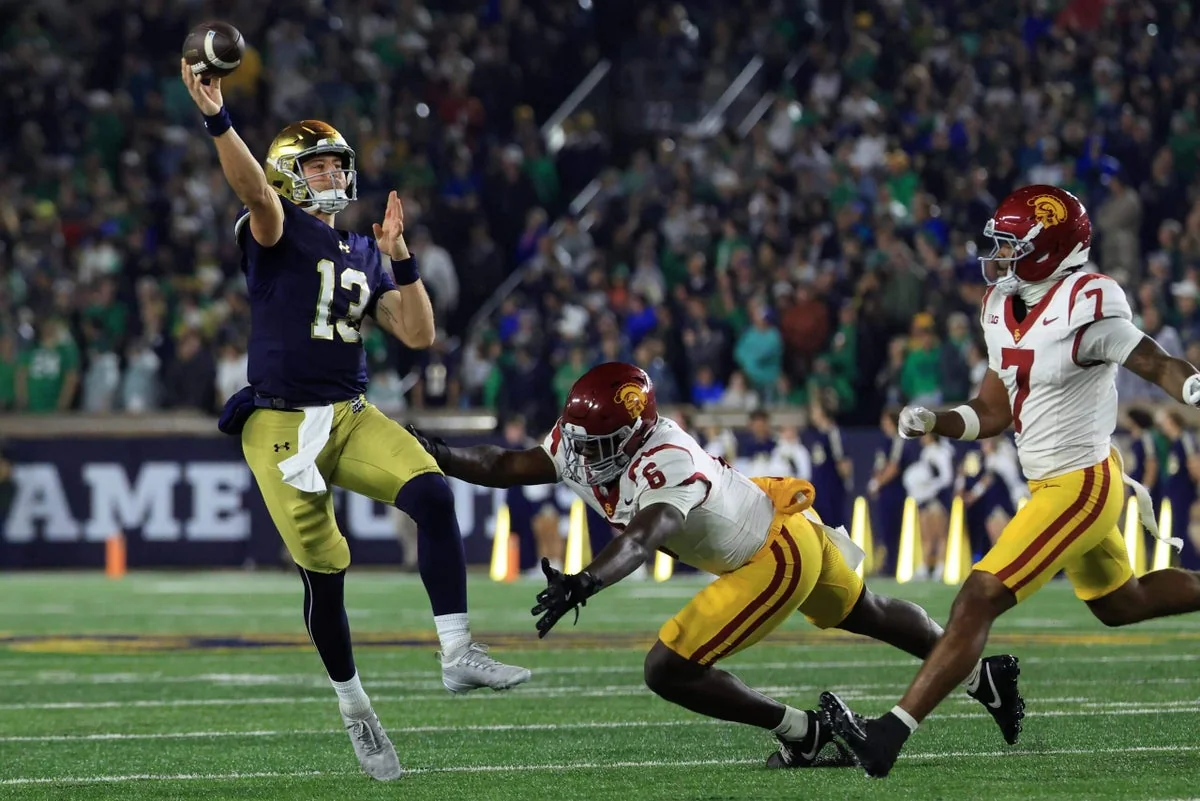
Notre Dame quarterback CJ Carr (13), who nearly did not secure the starting job, has transformed into a first-round NFL draft prospect. His journey from backup to potential top pick in just one season is nothing short of remarkable. Carr’s ability to attack every area of the field with his arm and his chemistry with Jeremiyah Love and Jadarian Price have been pivotal for Notre Dame’s offensive success.
According to Pete Sampson, a staff writer at The Athletic, “It’s all been a dizzying ascent for Carr, who went from nearly not winning the starting job to being projected as a first-round pick after next season.” This rapid rise in expectations places significant pressure on Carr but also highlights his potential and the impact he has had on Notre Dame’s success.
Defensive Improvement: A Season of Trial and Error
The Notre Dame defense, which started poorly with 98 points allowed through its first three games, has shown marked improvement. The Irish managed to lock down Arkansas, Boise State, and NC State in quick succession before reducing USC’s offense to a sparkler. Combined, the defense held those teams to four touchdowns under their scoring averages.
Notre Dame’s defensive coordinator Marcus Freeman acknowledges the challenges but remains optimistic about the team’s potential: “I wish I could tell you that there’s been a game that it was perfect, and it hasn’t been that. So you can’t rep something one time or maybe tell somebody, ‘Hey, if this happens, this is what we would do,’ and not practice it and have confidence that it’s going to be executed in the game.” Freeman’s emphasis on continuous improvement and preparation underscores the team’s commitment to excellence.
Key Players and Challenges Ahead
Several key players are expected to take on more significant roles as Notre Dame heads into its final five games. These include Joe Otting, who is ready or not for the starting center position, Tae Johnson, a redshirt freshman with star potential in the safety position, and Sullivan Absher, who could get a five-game run at left guard.
The Irish face significant challenges without their three best interior offensive linemen. Additionally, the loss of key defensive players has stretched Notre Dame thin on both sides of the ball.
However, Freeman is confident in his team’s ability to overcome these obstacles: “So you look for more. OK, we didn’t execute. Let’s go back and look at our process to Saturday and see where we failed and make sure that we enhance that preparation.” This approach reflects a commitment to continuous improvement and adaptation.
Looking Ahead: A Smooth Path to the College Football Playoff?
Notre Dame’s remaining schedule presents favorable matchups, with win probabilities of 94%, 91%, 73%, 96%, and 96% against Boston College, Navy, Pittsburgh, Syracuse, and Stanford respectively. Despite a bit of volatility in the offense, the defense seems to have found its rhythm.
For the Notre Dame Fighting Irish, success this season was always making the College Football Playoff (CFP) and rolling the dice on another run. With five games remaining, the team is closing on a 10-game win streak.
The final record: 10-2. This projection suggests that if all goes well, Notre Dame could find itself in the CFP once again.
The future remains uncertain, but with strong performances and continued improvement, Notre Dame’s path to success looks promising. As Freeman noted, “You just got to continue to rep it and rep it and then identify the problems after they happen and say, ‘OK, where in our process did we fail?’” This focus on process and preparation will be crucial as the season progresses.