Key Highlights
- A powerful geomagnetic storm caused brilliant auroras to appear over North America on November 11, 2025.
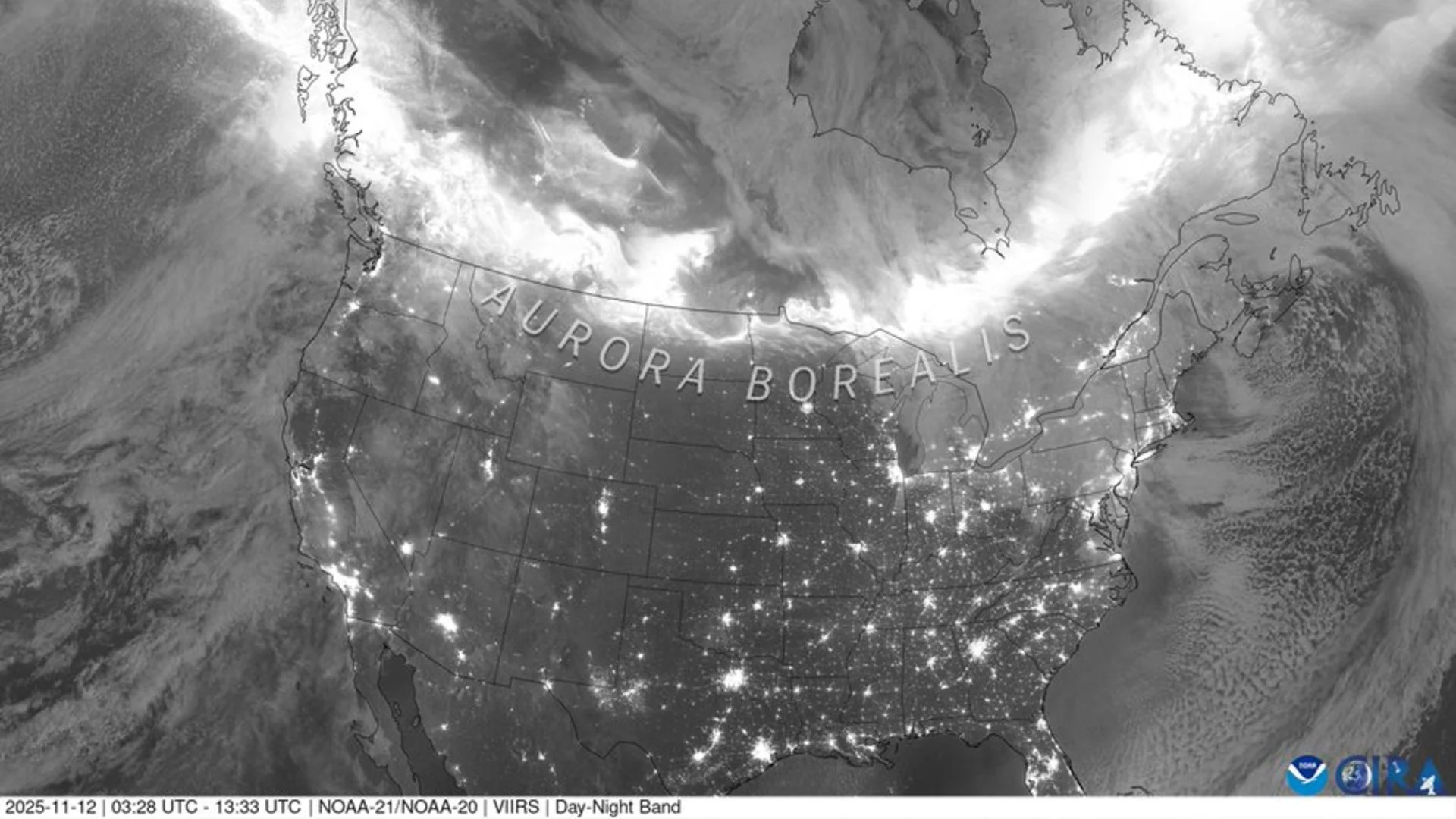
- The auroras were captured by the NOAA Joint Polar Satellite System’s polar-orbiting satellites.
- This event was triggered by a severe G4-class geomagnetic storm, one of the strongest in recent years.
- The northern lights were seen as far south as Texas and parts of Mexico due to the impact of a CME on Earth’s magnetosphere.
Brilliant Aurora Display Over North America
Astronomers and stargazers across North America, including the United States, Canada, and Mexico, witnessed an impressive display of northern lights on November 11, 2025. This spectacular celestial event was the result of a powerful geomagnetic storm that sent charged particles from the sun towards Earth.
Triggering the Aurora
A coronal mass ejection (CME) is a solar eruption that sends a cloud of plasma into space, often associated with intense solar flares. These CMEs can significantly affect our planet by impacting power grids and satellite navigation systems while also causing the auroras to appear more prominently.
Observation and Capture
The NOAA Joint Polar Satellite System’s polar-orbiting satellites captured a composite image of this rare event over North America. These satellites use both visible and infrared wavelengths to highlight where across the continent the auroral activity was most intense.
Impact on the Northern Lights
This G4-class geomagnetic storm, one of the strongest in recent years, supercharged the Earth’s magnetosphere, allowing charged solar particles to penetrate deeper into the atmosphere than usual. Typically confined to polar regions, this event caused the northern lights to be seen as far south as Texas and parts of Mexico.
The phenomenon resulted in vibrant waves of green, pink, and purple lights that captivated photographers and skywatchers across the continent. The auroras were visible throughout the evening, creating a breathtaking spectacle for those fortunate enough to witness it.
Expert Insights
Kenna Hughes-Castleberry, the Content Manager at Space.com, explains the science behind this event. “This stunning display was triggered by a severe G4-class geomagnetic storm caused by a CME that slammed into Earth’s magnetic field,” she states. The impact supercharged the planet’s magnetosphere, enhancing the auroral activity significantly.
Experts emphasize the importance of monitoring these events for their potential impacts on technology and infrastructure. “While the northern lights are a beautiful sight, they can also disrupt satellite operations and power grids,” adds Hughes-Castleberry. “Understanding and predicting such storms is crucial for mitigating any potential disruptions.”