Key Highlights
- A missed ball-strike call changed the course of Game 3 in the World Series.
- The Blue Jays lost a run-scoring opportunity due to confusion after the call.
- Home-plate umpire Mark Wegner called the pitch a strike when it appeared to be a walk.
- The incident led to a pickoff at first base, affecting the inning’s outcome.
The Missed Call and Its Impact on Game 3 of the World Series
On October 27, 2025, during the second inning of World Series Game 3, a critical moment unfolded that would alter the complexion of the game. Los Angeles Dodgers pitcher Tyler Glasnow threw what appeared to be a ball four to Toronto Blue Jays outfielder Daulton Varsho, but home-plate umpire Mark Wegner called it a strike.
Assuming they had walked, Toronto’s Bo Bichette, who had reached on a single, began shuffling toward second. After receiving the ball back from the catcher, Glasnow threw to Freddie Freeman at first, and Freeman tagged out Bichette. This pickoff play effectively changed the inning’s dynamics.
Varsho’s Confusion and The Analyst’s Insight
Daulton Varsho stood a few steps down the first-base line, confused in the loud environment of the stadium. On the Fox broadcast, analyst John Smoltz referred to Wegner’s strike call as “late” and “soft.” Former MLB umpire Dale Scott provided insight, noting that “Mark has a bit of a slow signal, but he voices the pitch beforehand.” Scott continued, explaining, “Obviously, the hitter thought it was a ball four and started walking away. I think the baserunner saw the batter starting to come toward first (and) thought it was a walk also.”
Post-Inning Analysis and Future Implications
The incident resulted in Varsho eventually walking to end an eight-pitch at-bat and advancing to third on an Alejandro Kirk single. However, the Blue Jays were unable to capitalize as Addison Barger struck out, and Ernie Clement hit a soft liner that was caught in center field to end the inning.
Instead of taking a 1-0 lead, this puzzling play left the Blue Jays scoreless in the second inning. The Dodgers soon took the lead on a home run from Teoscar Hernández.
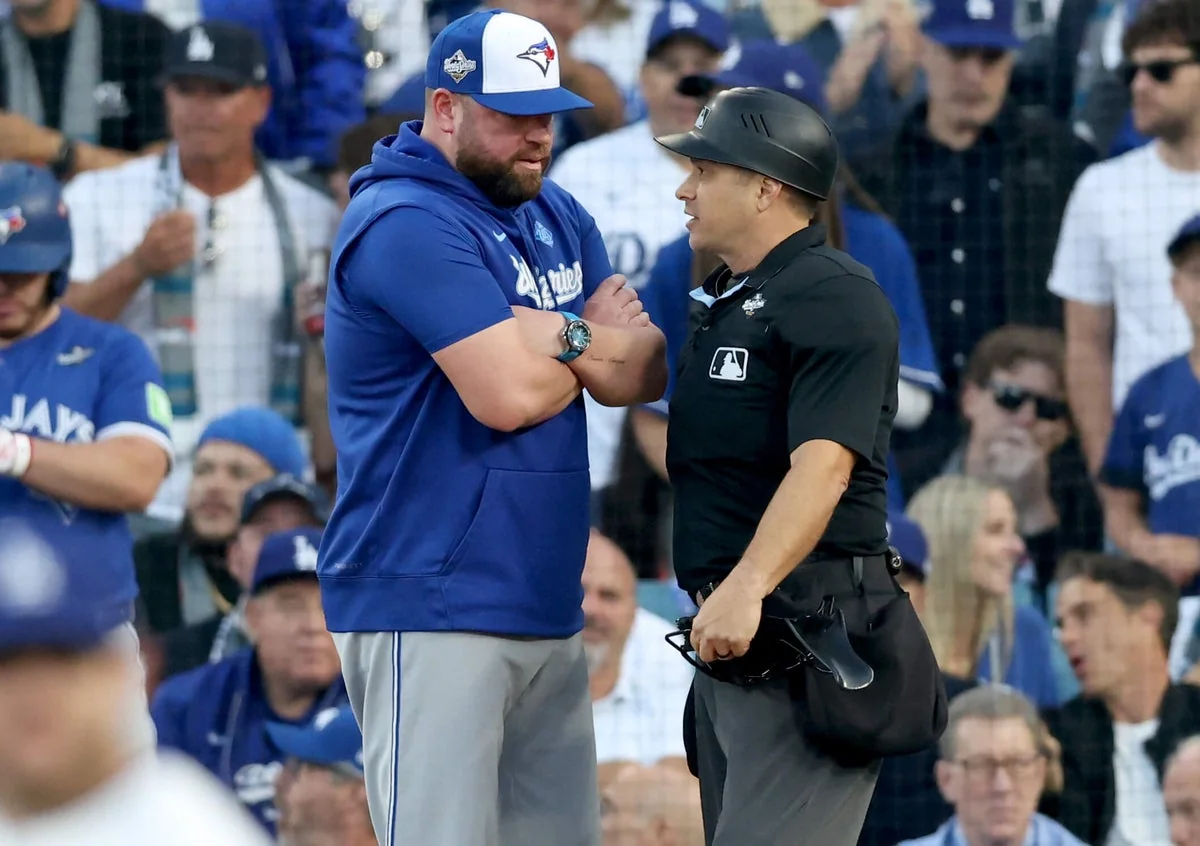
Blue Jays manager John Schneider had a lengthy talk with Wegner between innings, expressing concerns about the umpire’s timing.
“Mark is a great umpire, been doing it a long time,” Schneider said on the Fox broadcast. “Very delayed call, pretty deliberate. Just didn’t say anything, so Varsh thought it was a ball, and Bo assumed. I just asked him, in this environment, can he be a bit quicker or give a little more clarity so everyone kind of knows what’s going on.”
Asked about the play at first base, Schneider continued, “It’s a weird play. You don’t want that to come back and bite you, but you want to let the players decide what’s going on.”
Expert Perspective: Umpiring and Its Impact on Games
“One thing you cannot do as a runner is assume that a pitch is a ball or a strike,” Scott concluded. “Even though you think the ball is high like in this case, it’s nothing until the umpire calls, and whatever he calls it, that’s what it is.” This incident highlights the critical role of accurate call-by-call officiating in baseball.
The missed call serves as a reminder to all players about the importance of waiting for the official call before making any base running decisions. It also underscores the need for umpires to be more deliberate and clear with their signals, especially in high-pressure situations like the World Series.