not playing well is not near at the standard that it’s going to have to become.”
The Defensive Nightmare for Maryland
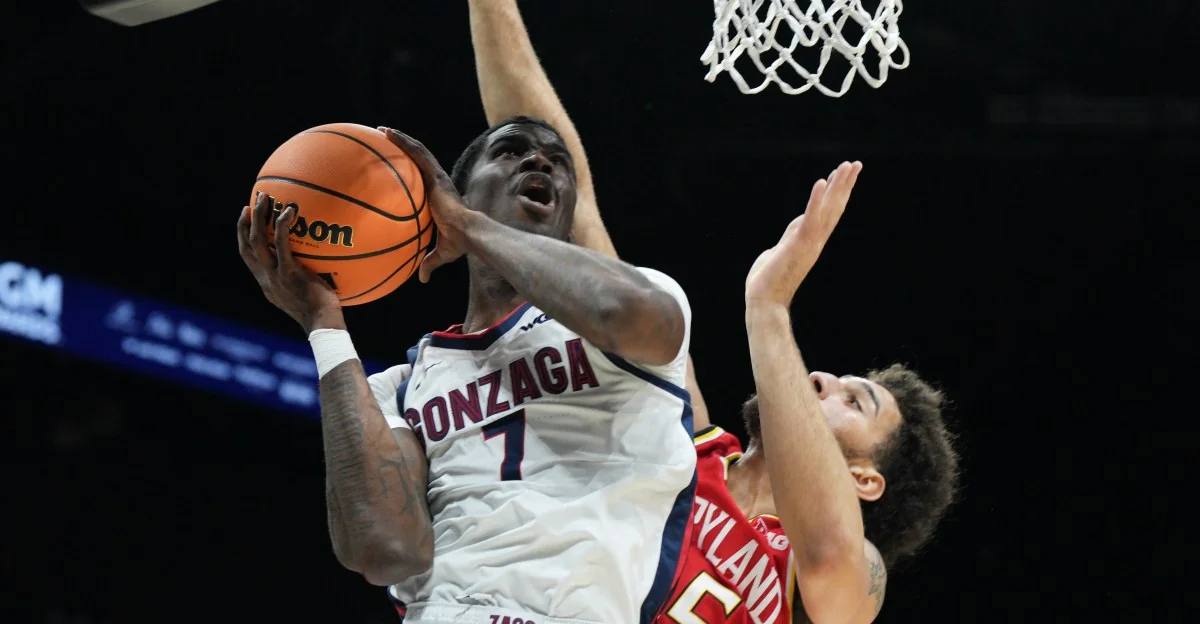
While the Terps attempted to push the tempo in hopes of igniting a spark, their efforts were thwarted by Gonzaga’s relentless pressure and efficient offense. The Bulldogs’ forwards proved particularly difficult to handle; Ike and Huff’s size and skill set made it challenging for Maryland to compete inside the paint.
The game was further complicated as Maryland struggled both inside and outside the arc, unable to stop Gonzaga from making key three-point shots. “Of all of the things that they’re the best at, shooting the three was what they were worst at, and they weren’t terrible,” Williams said, acknowledging the Bulldogs’ ability to execute their game plan effectively.
The Terps’ Struggle and Coach’s Response
Maryland’s offensive efforts were limited outside of Pharrel Payne, who scored six of the Terps’ first 11 points. When Payne picked up his second foul, Maryland found themselves unable to score for nearly four minutes. Despite Andre Mills’ circus shot that injected some life back into the game, Darius Adams baited a flagrant foul out of Graham Ike, giving the Terps an opportunity to respond.
However, any momentum gained was short-lived as the Bulldogs maintained their dominance. By halftime, Gonzaga had pulled away with a 22-point lead. “We were exposed on multiple levels, and that’s the ownership that we have to have,” Williams said. “And that includes me.”
Post-Match Analysis and Upcoming Challenges
Maryland’s bench struggled significantly against Gonzaga, with only Isaiah Watts making a basket in the first half. The Terps sorely missed George Turkson and Solomon Washington in the frontcourt. Overall, the Bulldogs dominated on both ends of the court, outscoring Maryland 51-9 off the bench.
Turnovers continued to be an issue for the Terps; they ended up with 18 total turnovers and allowed 100 points. “ score 100 in the first half if we turn it over 15 times in the first half,” Williams claimed at halftime, highlighting the team’s struggles.
With just 19 hours of rest between their game against UNLV and their final match of the tournament against No. 8 Alabama, Maryland will look to improve their performance in a critical game that could shape their season’s trajectory.
For now, the Terps are left reflecting on what went wrong and how they can turn things around. “As discouraging as it is, it’s encouraging that we get a chance to respond tomorrow,” Williams said. “How we go about the response is probably more important than the outcome of this game.”