Key Highlights
- The obsolescence of single-metric risk models like the VIX.
- The introduction of the Macro Risk Trinity to navigate complex market environments.
- The role of the MOVE Index in identifying bond market volatility.
- How credit spreads and volatility measures interact to signal economic stress.
The Shift from Single-Metric Models: The VIX’s Limitations
In recent years, financial markets have evolved significantly, necessitating a more comprehensive approach to risk management. For decades, the CBOE VIX served as the primary “fear gauge” of Wall Street. However, with the advent of new trading strategies and market structures, relying on a single metric like the VIX has become insufficient and potentially dangerous.
Two structural shifts have fundamentally altered its predictive power: the 0DTE blind spot and Goodhart’s law.
The VIX calculates implied volatility based on options expiring in 23 to 37 days, but today, massive institutional hedging flows occur intraday via 0DTE (Zero Days to Expiration) options. This creates a “Gamma Suppression” effect, where market makers’ hedging activities dampen realized volatility, effectively bypassing the VIX calculation window.
The Macro Risk Trinity: A Multivariate Approach
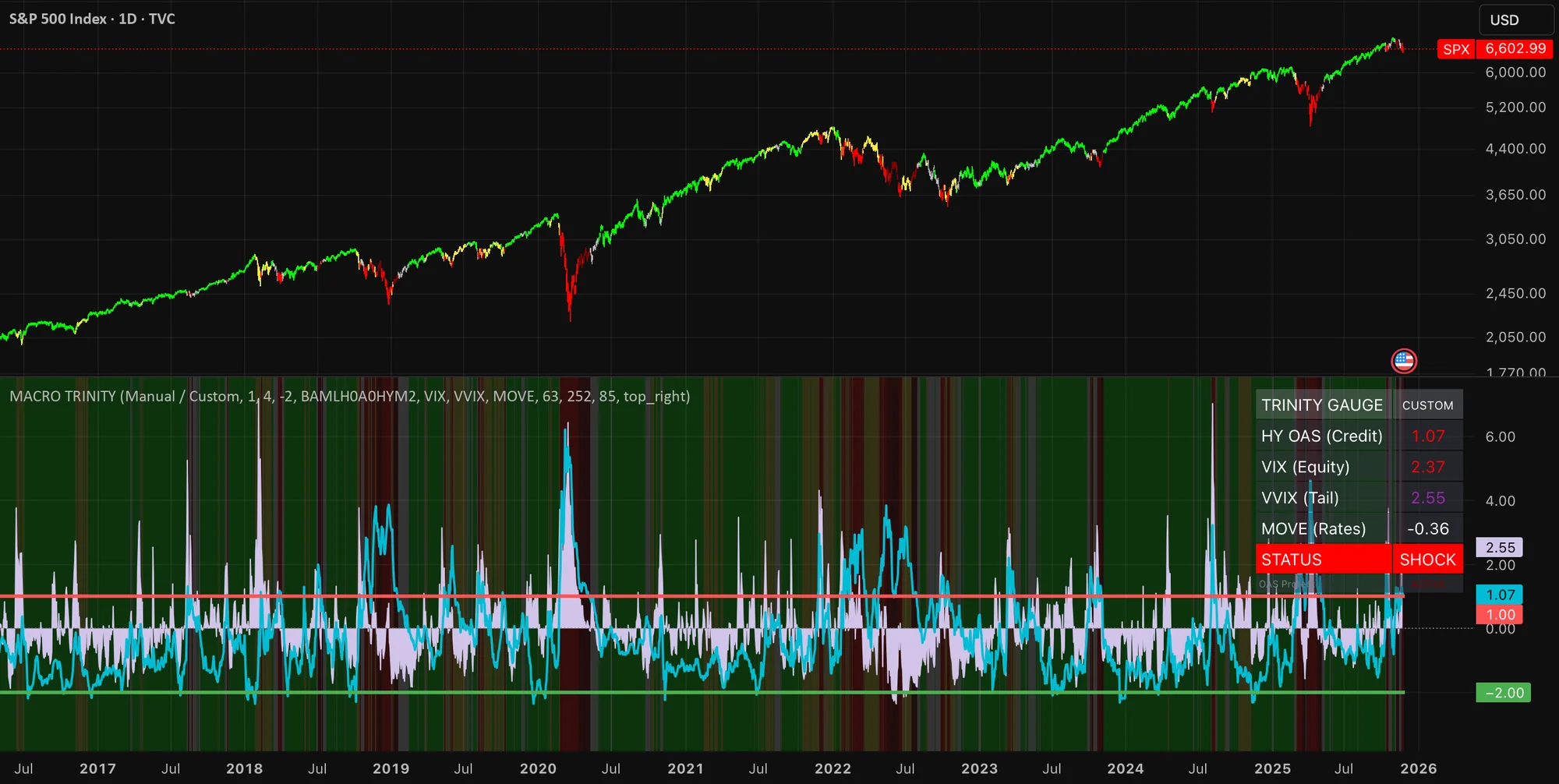
To accurately navigate this complex environment, Robinhoodl21 introduced the Macro Risk Trinity. This innovative model moves beyond simple price action by employing a multivariate analysis of three core pillars: Rates, Credit, and Equity. The logic is derived from three specific areas of financial research:
The Origin of Shock: Volatility Spillover Theory
Macroeconomic shocks typically do not start in the stock market; they originate in the US Treasury market. The MOVE Index acts as a “VIX for Bonds,” serving as an early indicator of equity distress. Research by Choi et al. (2022) demonstrates that bond variance risk premiums are leading indicators for equity distress.
Since the “Risk-Free Rate” is the denominator in every Discounted Cash Flow (DCF) model, instability here forces a repricing of all risk assets downstream. This highlights the critical role of the US Treasury market in shaping broader financial dynamics.
The Foundation: Structural Credit Models
While stock prices are often driven by sentiment and liquidity, corporate bond spreads (High Yield Option Adjusted Spread) are driven by balance sheets and math. Based on the seminal Merton Model (1974), equity can be viewed as a call option on a firm’s assets, while debt carries a short put option risk.
The theory posits that if the VIX is low but credit spreads (OAS) are widening, a divergence occurs. Mathematically, credit spreads cannot widen indefinitely without eventually pulling equity valuations down. This indicator identifies the specific divergence and helps traders understand when market conditions are deteriorating.
The Fragility: Knightian Uncertainty
By monitoring VVIX (Volatility of Volatility), we detect demand for tail-risk protection. When the VIX is suppressed but VVIX is rising, it signals that “Smart Money” is buying out-of-the-money crash protection despite calm waters. This is often a precursor to liquidity events where the VIX “uncoils” violently.
This indicator helps traders gauge the current market regime via the chart’s background color: Systemic Shock (Red Background), Macro Risk / Rates Shock (Yellow Background), Credit Stress (Maroon Background), Structural Fragility (Purple Background), and Bull Cycle (Green Background).
Technical Specifications and Real-World Implications
The Macro Risk Trinity is engineered for the daily timeframe, with institutional lookbacks of 63 days (quarterly) and 252 days (yearly). It includes a logic buffer to handle the ~24-hour reporting delay of Federal Reserve data. The tool relies on robust academic principles but acknowledges the risks associated with overfitting and adaptive market dynamics.
While this indicator is built on peer-reviewed financial literature, traders must use it responsibly and manage their risk.
It serves as a compass to gauge market regimes rather than an autopilot for trading decisions.
The Macro Risk Trinity offers a nuanced approach to understanding complex market environments by integrating multiple metrics. As financial markets continue to evolve, such multifaceted tools will become increasingly important for traders and investors seeking to navigate the ever-changing landscape of risk.