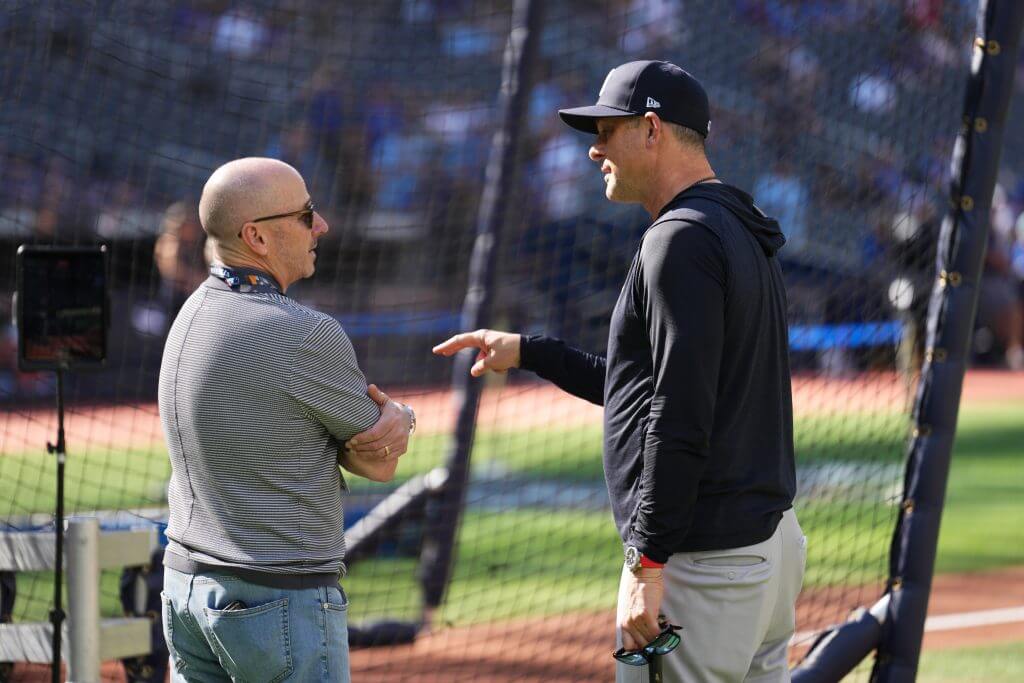
Key Highlights
- Brian Cashman denies interfering with manager Aaron Boone’s in-game decisions.
- Former Yankees players Alex Rodriguez and Derek Jeter criticized the front office for impacting managerial calls during games.
- Cashman has served as the Yankees’ general manager since 1998, emphasizing his commitment to not influencing on-field decisions.
- The disagreement highlights tensions between team management and player perspectives in professional sports.
Disagreement Over GM’s Role in Managerial Decisions
Brian Cashman, the General Manager of the New York Yankees since 1998, has vehemently denied any interference with manager Aaron Boone’s game-day decisions following a post-season critique from two prominent former players. During an interview on WFAN Sports Radio’s “Evan & Tiki” program, Cashman emphatically refuted claims made by Alex Rodriguez and Derek Jeter that the front office had unduly influenced managerial choices during the Yankees’ disappointing American League Division Series (ALDS) performance.
According to Cashman, these allegations stem from a misunderstanding. He asserts, “It’s not true, clearly,” adding, “Clearly, they don’t know.” Cashman maintains that his role involves strategic planning and personnel management rather than micro-managing on-field decisions. This stance is underscored by his statement: “At the end of the day, you put Joe Torre on a deposition, you put Joe Girardi under a deposition, or you put Aaron Boone under a deposition, I’ve never picked the lineup.” This comment echoes his long-standing philosophy that managers are granted autonomy in making in-game calls.
Former Players’ Perspective
During Fox Sports’ postgame broadcast after Game 4 of the ALDS, Rodriguez and Jeter offered support for their former manager. Jeter defended Boone by stating, “He sticks up for his players,” while acknowledging that “I’m not saying it from any inside knowledge, but I’m pretty sure Aaron’s not the one that’s calling every move that they make throughout the game.” Rodriguez agreed, adding, “Honestly, from the entire organization, he’s the one guy I would circle that is the least to blame.” These statements highlight a divide between player and management perspectives on team dynamics.
Industry Context and Implications
The dispute over GM interference in managerial decisions is not unique to the Yankees. In professional baseball, there has been ongoing debate about the appropriate level of front-office involvement in game-day operations. Cashman’s staunch defense of his role emphasizes a philosophy that prioritizes trust and autonomy for managers.
Industry experts suggest that such disagreements are common but can be detrimental if not managed properly. “It’s crucial for GMs to clearly communicate their roles and intentions to ensure there is no misalignment,” said Dr.
Robert Kestenbaum, an industry analyst focusing on team dynamics. “Clear boundaries help maintain the integrity of both management and coaching staff, fostering a collaborative environment.”
The tension between Cashman’s denial and Jeter’s assertions underscores the complexities in sports leadership. While Cashman maintains a hands-off approach to in-game decisions, his critics argue that such autonomy can lead to suboptimal outcomes, especially during high-pressure playoff situations.
Conclusion
The disagreement over GM interference in managerial decisions within the Yankees organization reflects broader discussions in professional sports about team management and player perspectives. Cashman’s steadfast defense of his role as a strategic leader rather than an on-field micro-manager highlights the importance of clear communication and mutual respect between front-office staff and coaching personnel. As the debate continues, it serves as a reminder of the delicate balance required to foster successful teamwork in high-stakes environments.