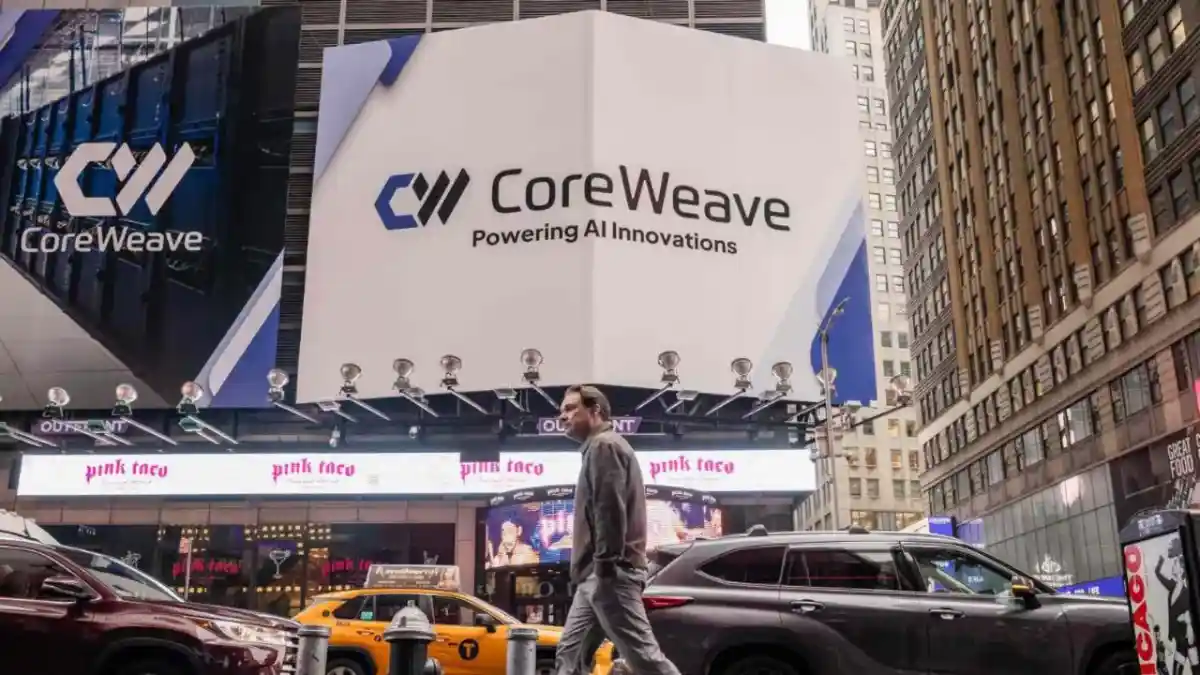
CoreWeave Stock Soars on Reported $14B Meta Deal: What It Means for AI Infrastructure, Investors & 2025’s “Limitless” Demand
TL;DR (for busy readers)
- What happened: CoreWeave reportedly signed an up to $14.2B AI cloud deal with Meta Platforms running through Dec 14, 2031 (with an option to extend). Shares surged on the news.
- Why it matters: It signals “limitless” AI compute demand from Big Tech, locking in long-dated GPU cloud capacity for Meta and cementing CoreWeave’s status as a premier AI infrastructure provider.
- The takeaway for investors: The deal may de-risk utilization, support revenue visibility, and lift long-term margins, but concentration risk, capex intensity, and valuation remain key watch-outs.
A Click-Worthy Snapshot (2025)
CoreWeave’s stock is climbing after reports of a multi-billion-dollar cloud infrastructure commitment from Meta, one of the world’s largest AI spenders. The agreement reportedly stretches through 2031 (with a potential 2032 extension), and the market is reading it as a bold confirmation: the AI compute cycle is far from over.
The size and term of the deal reinforce a theme dominating 2025: AI infrastructure has become a strategic resource, much like energy or bandwidth in earlier tech cycles. And vendors that can deliver Nvidia-class GPU clusters at scale—on time and at predictable pricing—are winning long, sticky contracts.
What Exactly Is in the Deal?
While the companies haven’t disclosed every line item, coverage indicates that Meta will secure AI cloud computing capacity from CoreWeave through December 14, 2031, with an option to extend into 2032. Reports also highlight access to next-gen Nvidia systems (e.g., GB300-class), aligning with Meta’s aggressive AI and data-center expansion in the U.S.
Key contours the market cares about:
- Term length & optionality: Multiyear runway (through 2031/32) gives both revenue visibility (CoreWeave) and compute certainty (Meta).
- Scale: ~$14.2B headline value puts this among the year’s largest AI cloud commitments.
- Hardware cadence: Signals deployment of latest-gen Nvidia GPUs and interconnects—critical for training and inference at scale.
Why Markets Are Calling AI Demand “Limitless”
Investors have been waiting for signals that the AI build-out is not just a 2023–2024 hype cycle. The Meta–CoreWeave pact is one of those hard-dollar confirmations. It arrives alongside CoreWeave’s prior mega-agreements across the ecosystem (OpenAI, Nvidia capacity arrangements), collectively pointing to sustained, multi-tenant demand for GPU cloud—not a one-off spike. Investopedia
Three demand pillars behind the enthusiasm:
- Foundation-model scale-up: LLMs are getting larger, more multimodal, and more specialized; model training/finetuning cycles require ever-bigger GPU clusters.
- Enterprise AI adoption: From recommendation engines to agentic workflows, enterprises are expanding AI inference footprints—less spiky than training and potentially higher-volume over time.
- Hardware scarcity premium: Even in 2025, best-in-class GPU capacity is constrained; long-dated contracts secure priority access and price predictability.
Stock Market Impact: Why Shares Popped
A long-term, multi-billion deal typically supports:
- Utilization & visibility: Locked-in demand reduces idle capacity risk.
- Pricing power: Committed volumes strengthen unit economics and capex planning.
- Strategic positioning: Reinforces CoreWeave as a go-to AI cloud for hyperscalers and AI leaders.
Reports today showed shares spiking ~9%–14% intraday on the headline—classic re-rating behavior when Wall Street sees de-risked revenue and optionality for operating leverage.
The Bigger Picture: From Crypto Roots to AI Cloud Leader
CoreWeave’s pivot from crypto mining (2017–2018) to AI-optimized cloud was a prescient shift. Post-IPO (2025), the company’s growth story has been tied to hyperscaler-adjacent demand and foundation-model workloads. The Meta contract extends that arc, potentially smoothing quarterly variability with a multi-year anchor client.
Strategy Breakdown: How CoreWeave Wins in AI Cloud
1) Specialization over general compute
CoreWeave focuses on GPU-dense data centers engineered for AI/ML throughput, low latency networking, and NVLink/InfiniBand fabrics. This is not commodity cloud; it’s high-performance AI infrastructure tuned for training and large-scale inference.
2) Supply chain orchestration
Tapping into Nvidia’s leading-edge GPUs and aligning deployment schedules with customer roadmaps is a moat. It requires deep vendor relationships, rapid rack-level rollouts, and power/cooling mastery for HPC-grade density.
3) Contracting for capacity
CoreWeave’s environment—long-dated buying from AI labs and platforms, coupled with arrangements to backfill or monetize unused capacity—helps manage the capex–utilization balance in a frothy market.
“Limitless” vs. “Priced for Perfection”: The Valuation Debate
Yes, AI demand looks enormous, but stocks ultimately discount cash flows and execution risk. Even bulls acknowledge several watch-outs:
- Concentration risk: Mega deals can mean client concentration; a shift in workloads or budget priorities can ripple through results.
- Capex intensity: Building GPU data centers demands heavy, ongoing investment—power, land, cooling, network fabrics—potentially pressuring free cash flow in aggressive build phases.
- Cyclicality of hardware: Supply improves; GPU cycles evolve. If prices normalize faster than expected, unit economics could compress.
- Macro sensitivity: AI capex is strategic, but it’s still capex—sensitive to rates, equity risk appetite, and C-suite priorities.
Bottom line: The Meta contract meaningfully de-risks near- to medium-term revenue, but investors should track gross margin, utilization, contract mix, and customer diversification as the capacity ramps.
Who Else Is Affected? Second-Order Ripples
- Nvidia & AI semis: Strong, multi-year GPU orders continue to validate Nvidia’s platform lead and support the broader AI semiconductor complex.
- Data-center REITs & power players: Sustained AI builds lift demand for wholesale colocation, substation-adjacent land, HV/MV infrastructure, and renewables/PPAs.
- Hyperscalers & AI labs: Expect more long-dated commitments as firms lock in GPU hour inventory to match product roadmaps.
- Networking & interconnects: InfiniBand/Ethernet fabrics, optical transceivers, and switch silicon vendors benefit from ongoing cluster scale-ups.
Investment Angle (Not Financial Advice)
Bull case:
- Long-term visibility from $14B+ commitments.
- Platform validation as a top-tier AI cloud.
- Operating leverage as new regions fill and mature.
Bear case:
- Execution risk on rapid build-outs.
- Potential pricing normalization as GPU supply catches up.
- Customer concentration and contract cliffs in outer years.
What to watch next:
- Pace of capacity deployments (quarterly adds, utilization targets).
- Contract wins beyond the top 3–4 AI customers.
- Margin trajectory as scale improves and procurement terms evolve.
- Any updates to 2025–2026 revenue guidance or capex plans.
Beginner-Friendly Explainer: Why GPUs & AI Cloud Matter
Think of AI infrastructure as the factory floor for modern intelligence. Instead of conveyor belts, you have GPU clusters; instead of raw steel, you feed in data; instead of stamping out parts, you train and run models that power search, recommendations, copilots, ads, and new agentic experiences.
- Training = teaching the model; compute-intensive, bursty, best served by state-of-the-art GPUs.
- Inference = using the trained model; more predictable, massive in volume, still benefits from modern accelerators.
- Why the rush to sign deals? Scarcity. Firms want guaranteed access to the best chips so they can ship products on time.
Practical Takeaways for Investors
- Time horizon matters: Multi-year deals help long-term holders more than short-term traders.
- Follow the backlog: Backlog and RPO (remaining performance obligations) trends can signal future revenue health.
- Margins tell the truth: Scale is great—but gross margin and cash conversion show whether scale is profitable.
- Diversification is king: Each new enterprise or platform customer reduces risk.
FAQs
Q1: How big is the reported Meta–CoreWeave deal and how long does it run?
A: Reports indicate an up to $14.2B agreement extending through Dec 14, 2031, with an option to 2032.
Q2: Why did CoreWeave’s stock jump on the news?
A: The market views multi-year, multi-billion contracts as de-risking events—they boost revenue visibility and support margin scale, justifying a higher valuation multiple.
Q3: What hardware is likely involved?
A: Reporting points to latest-gen Nvidia GPU systems (e.g., GB300-class), aligned with Meta’s continued AI data-center investments.
Q4: Didn’t CoreWeave just go public?
A: Yes. CoreWeave listed on the Nasdaq (CRWV) in March 2025, pivoting from its crypto origins to a specialized AI cloud model. CoreWeave
Q5: What are the risks even with a headline deal?
A: Execution/capex risk, customer concentration, potential pricing shifts as GPU supply improves, and broader macro pressures on AI budgets.
Conclusion
The reported $14.2B Meta contract is a milestone that does two things at once: it validates CoreWeave as a primary AI cloud partner and reaffirms the market’s conviction that AI compute demand is multi-year and compounding. For investors, the news suggests better visibility and scale economics, tempered by the real-world challenges of capex-heavy growth, customer concentration, and valuation discipline. If 2023–2024 was the GPU gold rush, then 2025 is shaping up to be the era of locked-in capacity—and CoreWeave just claimed a significant share of it. Barron’s+1
Note: This article is for informational purposes only and is not financial advice. Always do your own research and consider consulting a licensed financial professional before making investment decisions.