Key Highlights
- A new lawsuit from AFGE’s National VA Council claims VA Secretary Doug Collins violated President Trump’s executive orders on collective bargaining.
- The suit focuses on the actions of VA Secretary Collins in implementing and selectively enforcing the executive orders, rather than just challenging the president’s actions.
- Collins exempted roughly a half-dozen smaller unions from the executive order, which the union argues is based on political activity rather than national security concerns.
- The lawsuit accuses Collins of violating the terms of the executive order by exempting specific unions instead of the offices and agency subdivisions that employ their workers.
Background on Executive Orders and Unions in Government
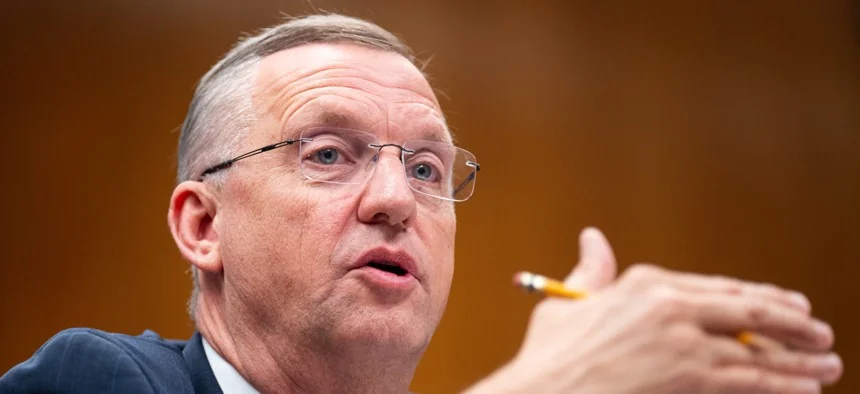
In November 2025, a new legal challenge was filed against the U.S. Department of Veterans Affairs (VA) regarding President Donald Trump’s executive orders aimed at stripping collective bargaining rights from federal employees. The lawsuit, brought by AFGE’s National VA Council, highlights concerns that Secretary Doug Collins has selectively applied these executive orders to certain unions.
These executive orders were issued in March and August 2025 with the intention of removing collective bargaining rights for two-thirds of the federal workforce on national security grounds. However, unlike previous legal challenges which focused solely on the legality of these executive orders, this lawsuit zeroes in on how they were implemented.
Specifics of the Legal Challenge
The complaint was filed on November 5, 2025, in the U.S. District Court for Rhode Island. It challenges Secretary Collins’ decision to exempt certain unions from the executive orders’ scope, arguing that this action was arbitrary and inconsistent with the law.
According to AFGE’s lawsuit, the termination of their union contract by Secretary Collins was “arbitrary and capricious, an abuse of discretion and contrary to law.” The suit further states that there was no rationale or justification for terminating collective bargaining rights on a union-by-union basis. Instead, it suggests that political activity rather than national security concerns were the deciding factor.
Impact on VA Employees
The selective enforcement of these executive orders has created confusion and inconsistency at individual VA facilities. Some employees continue to enjoy their union rights while others do not. This situation is particularly complex for VA firefighters and police officers, who belong to AFGE bargaining units organized by facility rather than job.
The lawsuit argues that the April 11 order, which exempts certain unions from the executive orders’ scope, has had a chaotic effect on VA operations. The union claims that this decision violates the terms of EO 14251 and has led to a division within bargaining units at different VA medical centers.
Legal Precedents and Future Implications
The case is part of ongoing legal challenges against these executive orders. AFGE’s national office had previously secured a preliminary injunction, halting the implementation of the executive orders for a period. However, this decision was later stayed by a three-judge panel on the Ninth Circuit Court of Appeals.
Now, as the entire Ninth Circuit considers overturning that decision and potentially blocking the edicts more broadly, this lawsuit adds another layer to the ongoing debate over federal labor laws and executive authority in shaping them. The outcome could have significant implications for future policy regarding collective bargaining rights in the federal government.
The case underscores the complex interplay between political decisions and legal frameworks governing union rights within government agencies, highlighting potential areas of abuse or misapplication of executive orders by agency heads.