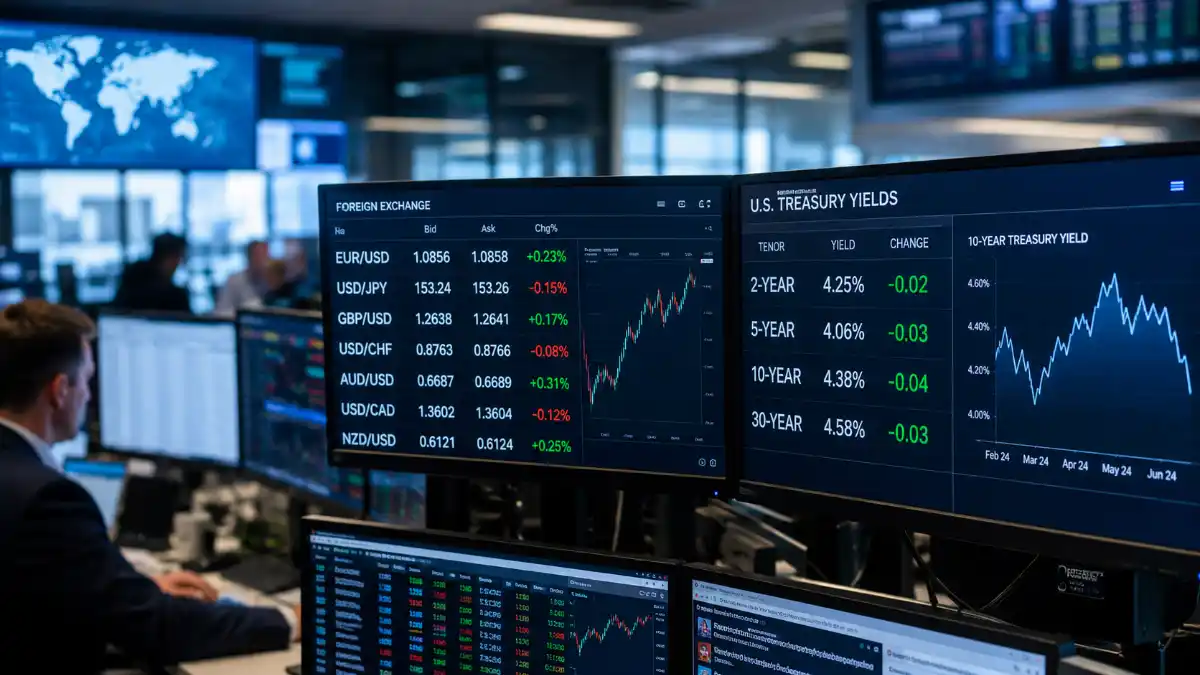
Foreign Exchange and Bond Markets Brace for Fed Minutes and Crucial China Economic Data
Global foreign exchange rates and U.S. Treasury bond markets are heading into a decisive trading week driven by two major catalyst events: the release of the Federal Open Market Committee (FOMC) July meeting minutes and key economic activity metrics from China. Institutional investors and foreign exchange traders are seeking clarity on the Federal Reserve’s monetary policy trajectory following a rare split vote, while simultaneously evaluating global demand dynamics coming out of the world’s second-largest economy.
What Happened?
The Federal Reserve is scheduled to publish the detailed minutes from its July 28–29 monetary policy meeting on Wednesday, August 19, at 2:00 p.m. Eastern Time. The July meeting concluded with the FOMC voting 9–3 to maintain the benchmark federal funds rate at its existing target range.
The decision was notable for featuring a unified dissenting block composed of three regional Fed presidents—Federal Reserve Bank of Cleveland President Beth Hammack, Federal Reserve Bank of Minneapolis President Neel Kashkari, and Federal Reserve Bank of Dallas President Lorie Logan—who voted in favor of a 25-basis-point interest rate increase. This marked the first instance since September 2016 that three FOMC policymakers dissented in the same direction at a single policy meeting.
Concurrently, financial markets are preparing to absorb fresh macroeconomic figures out of Beijing. The upcoming economic data releases, including industrial production and retail sales, follow first-half reports showing China’s GDP expanded by 4.7% year-on-year. Market participants are reviewing these figures to gauge whether internal policy support is stabilizing consumer demand and broad manufacturing activity.
Why It Matters
The upcoming FOMC minutes are expected to provide deeper insight into the debate surrounding U.S. inflation risks and economic growth momentum. A 9–3 vote highlights growing division within the central bank, and market participants will scrutinize the text to assess whether hawkish sentiment extends beyond the three dissenting members. If the minutes indicate broader internal concern regarding inflation persistence, interest rate expectations could shift, driving changes in Treasury bond yields and the U.S. dollar exchange rate.
Meanwhile, economic performance in China serves as a key driver of global trade, commodity prices, and foreign exchange valuations across major export-oriented economies. Evidence of sustained industrial output or recovering retail metrics could provide support for growth-sensitive currencies, such as the Australian dollar and Euro, while sluggish indicators may reinforce demand for safe-haven assets like the U.S. dollar and Japanese yen.
Key Details
| Indicator / Event | Release Date / Level | Market Significance |
| FOMC Meeting Minutes | Wednesday, August 19, 2:00 p.m. ET | Details internal debate behind the 9–3 decision to hold rates. |
| July FOMC Policy Vote | 9–3 (Hold Rate) | Three regional presidents dissented in favor of a 25 bps hike. |
| China Economic Data | Monthly Output & Sales | Key benchmark for Asian trade and global commodity demand. |
| 10-Year U.S. Treasury Yield | 4.68% (as of Aug 14) | Reflects benchmark borrowing costs and rate expectations. |
| 2-Year U.S. Treasury Yield | 4.17% (as of Aug 14) | Highly sensitive to short-term Federal Reserve monetary policy outlook. |
Who Is Affected?
- Fixed-Income Investors: Bondholders face potential capital price fluctuations depending on yield adjustments triggered by Fed sentiment.
- Foreign Exchange Traders: Currency market participants dealing in USD, EUR, AUD, and Asian currency pairs are exposed to shifts in rate differentials and international trade sentiment.
- Corporate Borrowers: U.S. businesses tracking corporate debt pricing rely on benchmark Treasury yields to determine refinancing costs.
- Multinational Companies: Firms operating internationally face balance sheet adjustments linked to shifting exchange rates and Chinese consumer demand.
Economic or Market Impact
The combination of Fed commentary and Chinese economic releases directly influences global financial conditions:
- U.S. Treasury Yields: The 2-year Treasury yield, standing at 4.17%, remains sensitive to policy rate forecasts. If the minutes reveal that more FOMC members considered voting for a rate hike, short-term yields could rise. The 10-year yield, last recorded at 4.68%, will reflect broader expectations for long-term growth and inflation.
- Foreign Exchange Markets: The U.S. Dollar Index (DXY) could experience upward pressure if the minutes emphasize hawkish policy options. Conversely, currencies aligned with Asian economic growth, such as the Australian dollar, will respond to Chinese trade and production figures.
- Commodities: Global industrial metals, energy benchmarks, and agricultural exports remain tied to economic activity indicators originating from China.
What Happens Next?
Following the publication of the FOMC minutes on August 19, market attention will turn to several key scheduled economic releases:
- Jackson Hole Economic Symposium: Central bankers and economists gather later in the week for the annual economic policy conference in Jackson Hole, Wyoming.
- U.S. Second-Quarter GDP (Second Estimate): The U.S. Bureau of Economic Analysis is set to release its revised Q2 GDP figures on Wednesday, August 26, following an advance reading of 1.5% annualized growth.
- Personal Consumption Expenditures (PCE): Detailed consumer spending and inflation data feeding into the Fed’s preferred index will publish alongside the late-August economic updates.
What This Means for U.S. Investors and Market Participants
For individual market participants and institutional investors, the upcoming week presents an environment of potential asset re-pricing. Realignments in bond yields can directly affect mortgage interest rates, consumer credit pricing, and fixed-income portfolio values. Investors managing international portfolios should monitor currency exposures, as shifts in monetary policy expectations between the Federal Reserve and international central banks often generate short-term market volatility.
5. FREQUENTLY ASKED QUESTIONS
Q: When will the July FOMC meeting minutes be released?
A: The Federal Reserve is scheduled to publish the minutes of its July 28–29 meeting on Wednesday, August 19, at 2:00 p.m. Eastern Time.
Q: Why was the July FOMC vote significant?
A: The policy committee voted 9–3 to maintain interest rates, but three regional Fed presidents dissented in favor of a 25-basis-point rate increase. This was the first three-way same-direction dissent on the committee since September 2016.
Q: How do China’s economic figures affect U.S. markets?
A: China is a major global consumer of commodities and manufactured goods. Economic activity data from China influences international trade volumes, corporate earnings for multinational companies, and global risk appetite across equity and currency markets.
Q: Where do U.S. Treasury yields currently stand?
A: As of mid-August 2026, the 10-year U.S. Treasury yield was recorded at 4.68%, while the 2-year U.S. Treasury yield stood at 4.17%.
Q: What comes after the FOMC minutes on the financial calendar?
A: Investors will monitor speeches from the Jackson Hole Economic Symposium as well as the second estimate of U.S. Q2 GDP and Personal Consumption Expenditures (PCE) data due late in the month.
6. BOTTOM LINE
Financial markets are entering a pivotal period as traders process the internal policy dynamics of the Federal Reserve alongside macroeconomic data from China. The upcoming FOMC minutes will offer crucial insights into the 9–3 rate vote, serving as a primary signal for interest rate expectations, U.S. Treasury yields, and foreign exchange valuations in the near term.