Treasury Yields Rise as Oil Prices Jump Ahead of Key U.S. Inflation Data
U.S. Treasury yields moved higher as rising oil prices renewed inflation concerns, while investors turned their attention to this week’s consumer and producer price reports for clues about the Federal Reserve’s next interest-rate move.
What Happened?
U.S. Treasury yields moved higher Tuesday as a renewed rise in oil prices increased concerns that energy costs could keep inflation elevated.
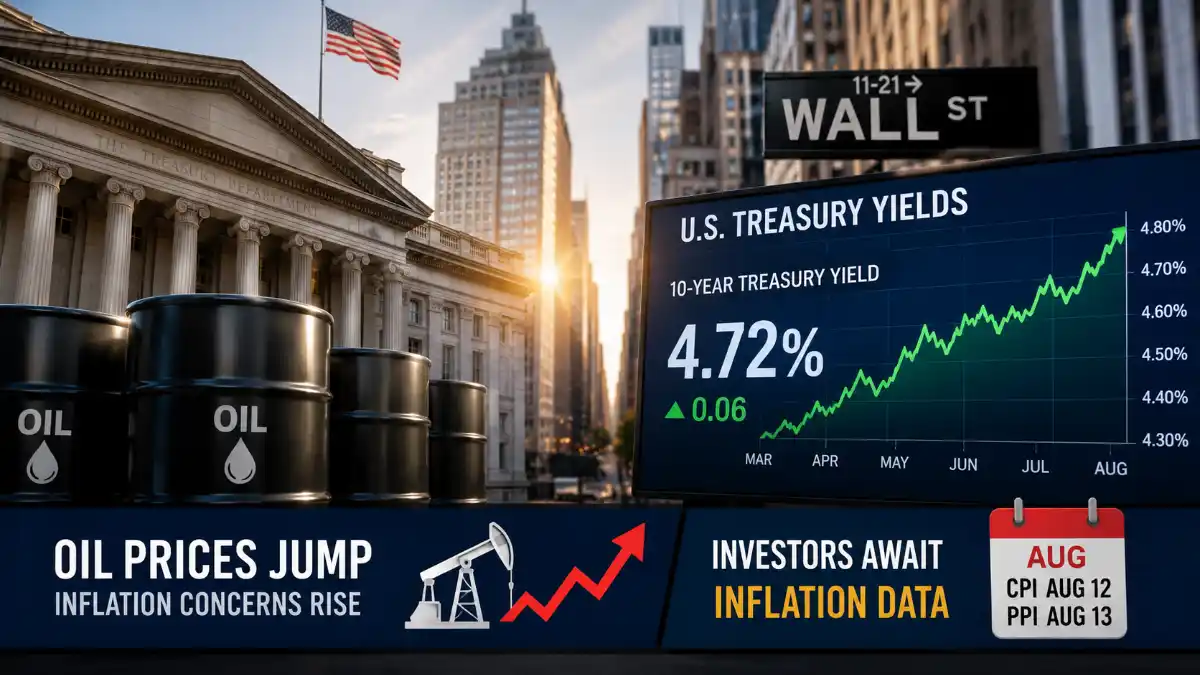
The benchmark 10-year Treasury yield rose to around 4.72%, while the move in oil prices added pressure to the bond market as investors reassessed the outlook for U.S. inflation and Federal Reserve policy.
The market’s attention is now shifting toward two major inflation reports due later this week. The U.S. Bureau of Labor Statistics is scheduled to release the Consumer Price Index for July on Wednesday, August 12, at 8:30 a.m. Eastern Time. The July Producer Price Index is scheduled for Thursday, August 13, also at 8:30 a.m. ET.
That makes the inflation data particularly important for Treasury markets, where investors are already weighing the potential impact of higher energy prices on the Federal Reserve’s interest-rate path.
Why Treasury Yields Are Rising
Treasury yields generally rise when bond prices fall. In the current environment, one of the main concerns is whether higher oil prices will feed into broader inflation.
Oil is an important input for transportation, manufacturing and other parts of the economy. A sustained increase in energy costs can raise consumer and business expenses, potentially making it more difficult for inflation to move lower.
Recent Federal Reserve analysis has highlighted the sensitivity of energy prices to the conflict in the Middle East. The Fed’s July Monetary Policy Report said PCE energy prices had risen sharply through May, while Treasury yields had also increased on net since the beginning of the year.
That backdrop has made investors particularly sensitive to fresh changes in crude prices.
Oil Prices Add to Inflation Concerns
The latest rise in oil prices has been closely linked to continuing uncertainty surrounding the Middle East and the security of energy supplies.
On Monday, WTI crude futures rose about 5.1% to $82.13 a barrel, while Brent crude gained about 5% to $87.72, according to market reporting. The move came amid renewed uncertainty involving Iran and the Strait of Hormuz, a critical route for global oil shipments.
Higher crude prices can affect inflation expectations because energy costs feed directly into gasoline and other fuel prices and can also increase transportation and production costs.
For Treasury investors, the concern is not simply the current price of oil. The bigger question is whether an extended energy-price shock could keep inflation higher for longer.
Investors Await July CPI Data
The next major test comes Wednesday morning when the Bureau of Labor Statistics releases July CPI data.
The most recent available national CPI report showed that consumer prices increased 3.5% over the 12 months ended June, while the index excluding food and energy increased 2.6% over the same period. Energy prices were up 15.7% year over year in June, with gasoline prices rising 26.7%.
The July report will therefore provide an important update on whether price pressures are continuing to ease or whether higher energy costs are beginning to create additional inflation pressure.
Investors will pay particular attention to both headline inflation and the core measure, which excludes food and energy and is closely watched when assessing underlying price trends.
The Fed’s Rate Outlook Is Back in Focus
Treasury yields are closely linked to expectations for future interest rates.
Shorter-term Treasury yields tend to be particularly sensitive to expectations for Federal Reserve policy, while longer-term yields reflect a broader combination of expected rates, inflation and economic growth.
Recent market moves suggest investors are reassessing the possibility of higher U.S. interest rates as energy prices rise.
A stronger-than-expected inflation reading could reinforce expectations that the Federal Reserve will need to maintain a restrictive policy stance for longer. Conversely, a softer inflation report could reduce some of the pressure on Treasury yields by strengthening expectations that inflation is cooling.
The July CPI and PPI reports will therefore be important not only for the bond market but also for expectations across stocks, currencies and other financial assets.
What Higher Treasury Yields Mean for Americans
Treasury yields do not move in isolation from the broader economy.
Higher government bond yields can influence borrowing costs across the financial system, including rates on mortgages, corporate debt and other forms of credit.
The 10-year Treasury yield is particularly important because it serves as a reference point for many longer-term borrowing costs.
For households, that means persistent increases in Treasury yields can contribute to higher financing costs, although the effect on individual products depends on other market conditions and the specific loan.
For savers and investors, higher Treasury yields can also make government securities more attractive relative to periods when yields are much lower.
What It Means for Investors
The combination of higher oil prices, elevated Treasury yields and upcoming inflation data creates a potentially volatile environment for financial markets.
Bond investors are watching closely for signs that inflation is becoming more persistent.
Equity investors, meanwhile, are assessing how higher interest rates could affect company valuations and borrowing costs.
Energy companies can benefit from higher crude prices, but industries that are sensitive to interest rates or operating costs may face different pressures.
The key issue is whether the current increase in energy prices proves temporary or becomes a more persistent source of inflation.
What Happens Next?
The immediate focus is the U.S. inflation calendar.
The Bureau of Labor Statistics is scheduled to release July CPI on August 12 at 8:30 a.m. ET, followed by July PPI on August 13 at 8:30 a.m. ET.
Investors will compare the new inflation readings with recent economic data and changing oil prices.
The results could influence expectations for the Federal Reserve’s future policy decisions and, in turn, Treasury yields.
The market reaction will depend not only on whether inflation rises or falls, but also on how the data compares with expectations and which components are responsible for any change.
Frequently Asked Questions
Why are Treasury yields rising?
Treasury yields have been moving higher as investors reassess inflation and interest-rate risks, with rising oil prices adding to concerns about future price pressures.
What inflation data is coming this week?
The July Consumer Price Index is scheduled for August 12, followed by the July Producer Price Index on August 13. Both releases are scheduled for 8:30 a.m. Eastern Time.
Why does oil affect Treasury yields?
Higher oil prices can increase inflation pressure. If investors believe inflation will remain elevated, they may expect interest rates to stay higher for longer, which can push Treasury yields higher.
Why is the 10-year Treasury yield important?
The 10-year Treasury yield is a major benchmark for financial markets and influences borrowing costs across the economy, including mortgages and corporate financing.
Could a weaker CPI push Treasury yields lower?
A softer-than-expected inflation reading could reduce expectations for prolonged restrictive monetary policy and potentially support Treasury prices, which would generally push yields lower. The actual market reaction would depend on the full inflation report and other economic conditions.
Bottom Line
Treasury yields are facing renewed upward pressure as higher oil prices raise concerns about inflation and the Federal Reserve’s future policy path. The next major test comes with the July CPI report on Wednesday, followed by PPI on Thursday.
For markets, the central question is whether the latest energy-price increase remains temporary or develops into a broader and more persistent inflation problem.