Key Highlights
- Burns’s six-part series “The American Revolution” fails to provide a unified narrative of the American origins.
- The documentary includes conflicting narratives on slavery and Native Americans’ roles in the revolution.
- Burns’s effort is seen as an attempt to honor all sides of history without fully addressing the contradictions.
- Reviewers critique the film’s failure to clearly explain the significance of the American Revolution.
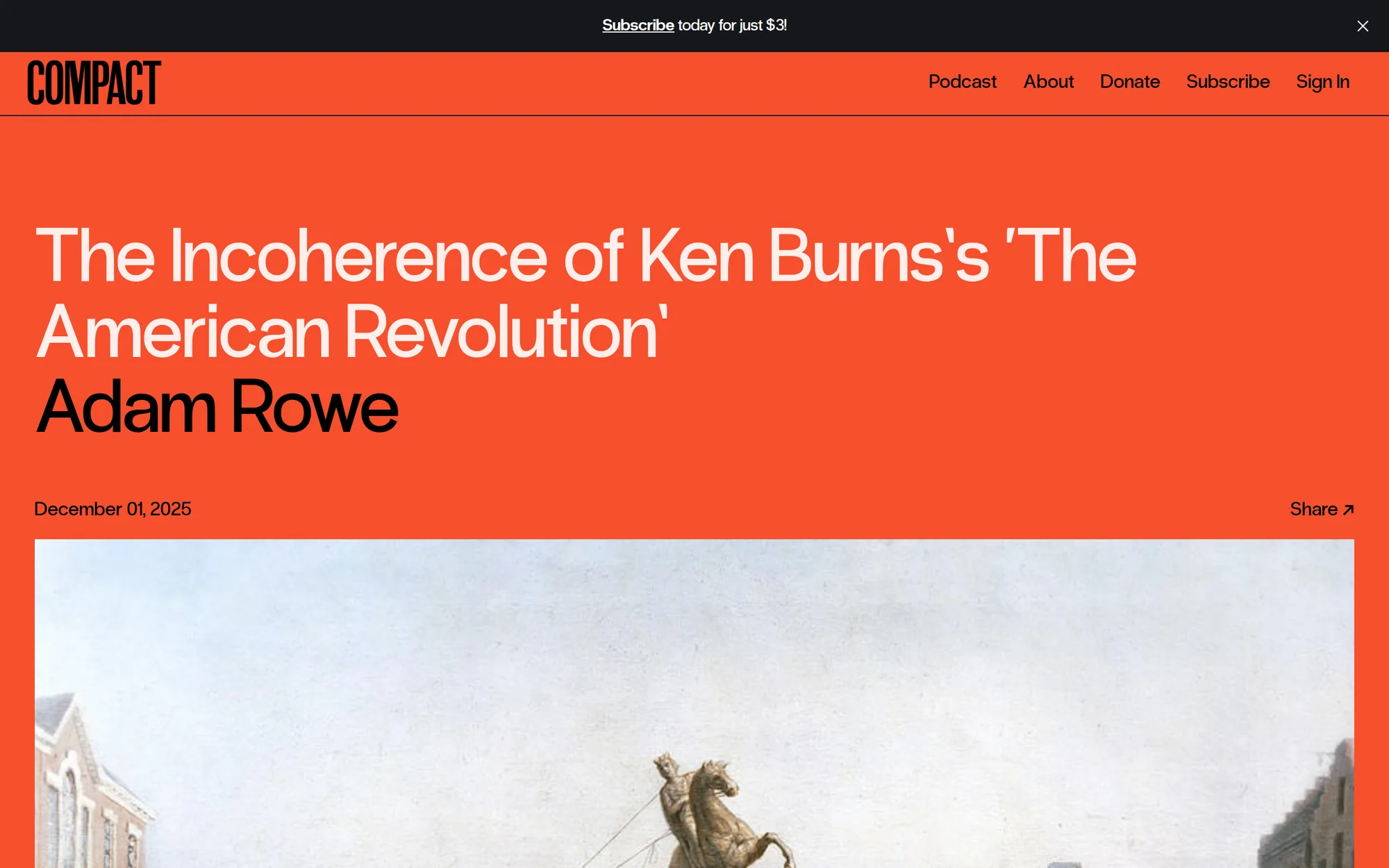
The Incoherence of Ken Burns’s “The American Revolution”
Ken Burns has embarked on a monumental yet, in his own admission, challenging task with his six-part, twelve-hour documentary series, “The American Revolution.” The project began nearly a decade ago, coinciding with the so-called Great Awakening. This period saw heightened cultural and ideological fervor, but Burns’s approach to retelling history remains rooted in conveying the mainstream historical consensus rather than engaging in overt political polemic.
The Conflicting Narratives
The documentary is structured around three overlapping narratives. One focuses on the traditional military history of the War for Independence. The second explores the story of American slaves striving to realize their own freedom, a struggle that sometimes aligned with the Patriot cause and more often arrayed them against it.
The third narrative centers on Native Americans fighting to maintain their sovereignty as a new nation emerged among them.
These narratives are tied together by an overarching argument: that Americans have never been a unified or harmonious people. American history, according to Burns’s documentary, is marked by conflict and division. This perspective challenges the notion of a singular, cohesive national origin story, which has become increasingly politicized in recent years.
Ken Burns’s Approach
Burns’s effort to convey this complex narrative through ecumenical sympathy and respect for all those who played their part in the nation’s founding is commendable. His film is described as an “almost heroic effort” to demonstrate that it is possible to show admiration for the oppressed and forgotten victims of America’s history without unduly traducing its traditional heroes.
However, Burns faces a significant challenge: the title of his series is misleading. A more apt title would have been something like “The American Wars for Independence.” The term “Revolution” typically refers to the political overthrow of the British Empire and monarchy and the creation of a constitutional republic, which was the most democratic in the world at that time.
The Omissions
Burns’s series highlights numerous injustices faced by American slaves and Native Americans but fails to explain what the Patriot cause was ultimately about. The sudden intrusion of countless ordinary Americans into politics, where they had never before played a prominent part, is barely addressed on screen.
The military effort of the Patriots is described in great detail and with beautiful visual effects, yet their cause remains poorly explained. General Washington’s leadership and the courage, skill, and sacrifices of those who fought are celebrated, but the film avoids explaining what all this heroism was for. The final episode opens with a historian’s quote that, while eloquent, is ultimately meaningless: “To believe in America, rooted in the American Revolution, is to believe in possibility.”
The Conclusion
The documentary’s final minutes include a cursory summary of the failures of the Articles of Confederation and the framing and ratification of the Constitution. While Burns attempts to balance power and liberty, his approach often feels vague and even unintelligible.
Ultimately, “The American Revolution” reflects an old-fashioned liberal’s patriotic reverence for America’s past. However, this reverence is now an amorphous sentiment without positive convictions.
The film’s failure to take a definite position on what the great event was ultimately about leaves it incoherent and incomplete. As historian Jane Kamensky of Harvard and the Thomas Jefferson Foundation notes, “Jefferson clearly didn’t take that seriously as a slaveholder, but I do.” This quote encapsulates the series’ struggle to reconcile its respect for the Founders with the harsh realities of their historical legacy.
While Burns’s documentary is well-crafted in many aspects, it ultimately fails to provide a clear and cohesive narrative. As Adam Rowe, an assistant professor of history at New College, Florida, concludes, “The story of our Revolution is not over.” Indeed, the ongoing debate about America’s past will continue, as this series itself demonstrates.